

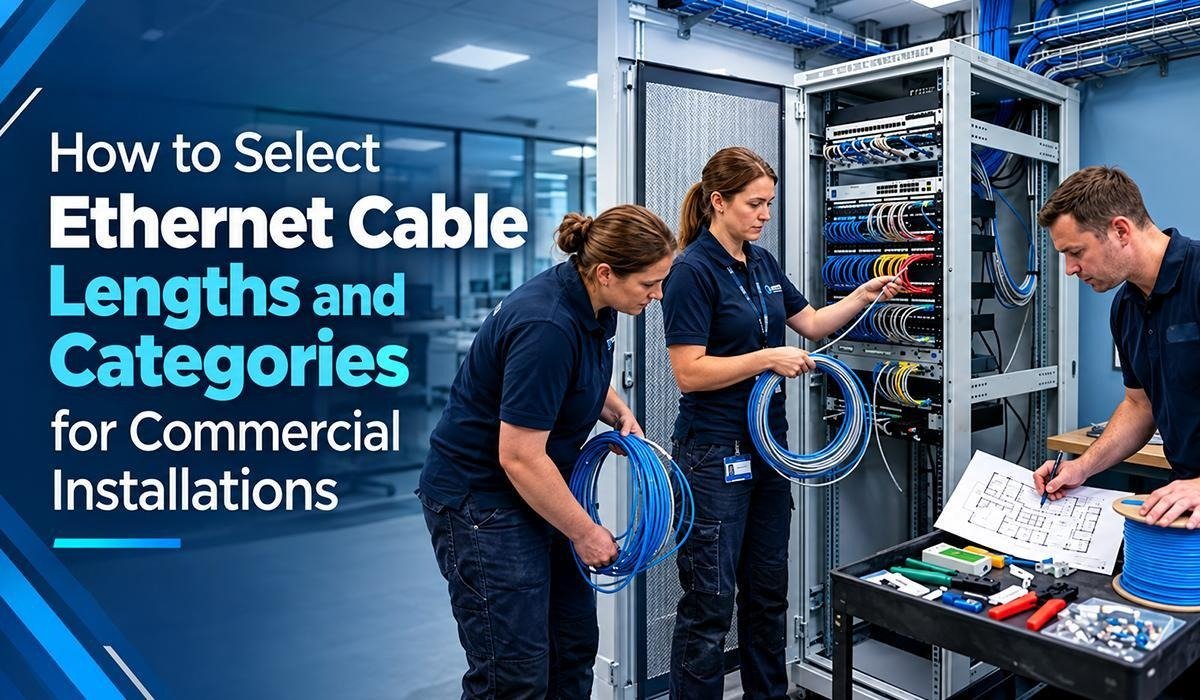
Commercial network installations require more planning than simply choosing a cable that fits the budget. Contractors need to consider the distance between telecommunications rooms and work areas, the number of connections, expected network speeds, and the physical environment where cables will be installed.
A cable that works well for a short office run may not be the best choice for a larger deployment. Likewise, buying longer boxes without calculating actual requirements can increase waste.
Understanding cable categories and planning lengths together helps businesses create reliable networks while controlling material costs.
Measure Before You Buy
Accurate measurements should come before bulk cable purchasing. Start by identifying the locations of network outlets, patch panels, switches, and telecommunications rooms. Then estimate the route each permanent cable will follow rather than measuring only the straight line between two points.
Cable pathways often pass through ceilings, walls, racks, and other spaces. These routes can add significant distance to a network run. Contractors should also account for the cable needed at both termination points.
A 1000 foot box can be useful for many commercial installations because it provides a substantial amount of cable for multiple runs. However, the quantity should still be based on the project layout. Cat5e cable 1000ft box is suited for a project with numerous standard connections, but purchasing several boxes without calculating the expected usage can leave excess material behind.
Understand Cable Categories
Ethernet categories indicate the performance capabilities of twisted pair cabling. Cat5e and Cat6 are common choices for commercial networks, but they are not identical.
Cat5e supports Gigabit Ethernet over standard channel lengths and remains suitable for many offices, classrooms, retail spaces, and similar environments. Cat6 provides higher frequency performance and greater headroom for demanding installations.
The category should be selected according to the network equipment, application requirements, and expected service life of the installation. Paying more for a higher category is not automatically better if the network has no practical need for it. At the same time, choosing a lower category solely because it costs less can create limitations when network requirements increase.
Match Category to the Application
Cable category becomes easier to select when the intended application is clear.
Standard Office Connections
Cat5e is often sufficient for workstations, printers, and other devices operating at Gigabit Ethernet speeds. It can provide a practical balance between performance and material cost for conventional installations.
Higher Performance Networks
Cat6 can provide additional performance headroom for businesses deploying newer networking equipment or planning for higher bandwidth requirements. It is particularly useful when the cabling is expected to remain in place for many years.
Power Over Ethernet
Power over Ethernet, commonly called PoE, allows compatible devices to receive power and data through Ethernet cabling. Wireless access points, security cameras, and VoIP phones are common examples. Contractors should verify cable specifications, installation conditions, and equipment requirements before deploying PoE at scale.
Choosing the category becomes much easier when these application requirements are established before purchasing materials.
Follow Length Limits
Standard copper Ethernet channel planning generally uses a maximum channel length of 100 meters, which includes the permanent link and patch cords. The permanent horizontal cable is normally planned within a shorter limit to leave room for connections at both ends.
Exceeding recommended distances can affect signal performance. When a commercial space requires longer links, contractors should not simply use more copper cable. The network design may need an intermediate connection point, active equipment, or fiber optic cabling.
Longer cable also requires more careful routing. Every additional bend, pathway change, and termination point should be considered during planning.
Reduce Installation Waste
Cable waste can quickly increase project costs when dozens or hundreds of runs are involved. Contractors should estimate each run as accurately as possible and group installations according to their location.
Useful practices include:
- Measure actual pathways instead of relying on straight line distances.
- Record estimated lengths for individual cable runs.
- Keep cable types clearly labeled during installation.
- Plan spare connections without installing unnecessary cable.
- Track remaining cable after each installation phase.
These simple steps make bulk cable management easier and provide a clearer picture of material consumption as the project progresses.
Check the Installation Environment
Cable selection is also affected by where the cable will be installed. Commercial buildings can contain plenum spaces, vertical pathways, raised floors, and other areas with different requirements.
Plenum rated cable is designed for installation in air handling spaces where applicable building codes require that rating. Riser rated cable is intended for vertical runs between floors. Contractors should confirm the required jacket rating with project specifications, local codes, and the applicable authority before installation.
The conductor construction matters as well. Solid copper horizontal cable is commonly used for permanent structured cabling, while stranded cable is typically used for flexible patch connections. A 1000ft 23AWG Cat6 500MHz UTP solid cable can therefore be appropriate for permanent commercial cabling when its specifications match the project requirements.
Conclusion
Selecting the correct cable is only part of a successful installation. Each completed run should be checked for continuity and correct wire mapping. Larger commercial projects may also require certification testing to verify that the installed cabling meets the required performance standard.
Documentation should record cable identifiers, termination locations, pathways, and test results. This information becomes valuable when a business adds equipment or experiences a network problem.
Careful planning ultimately makes cable selection much easier. By measuring actual routes, matching categories to applications, respecting length limits, and selecting the correct cable construction for each environment, contractors can create commercial networks that remain reliable and easier to expand.
