

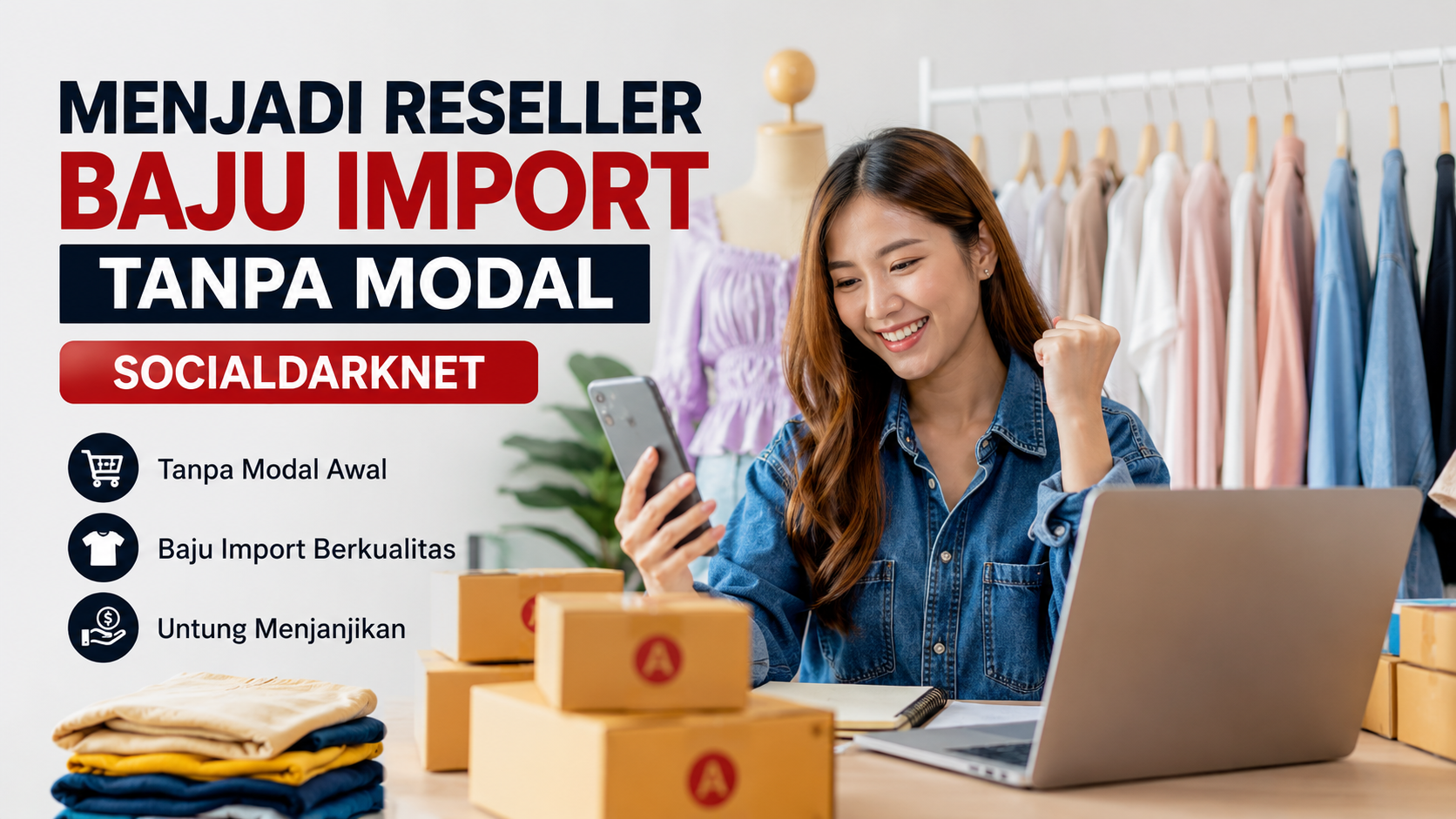
“Menjadi Reseller Baju Import Tanpa Modal Socialdarknet” looks like the name of a reseller program at first glance, but current evidence points to a different conclusion. Socialdarknet.com is currently presented as “SocialNews,” a general-content website with sections for Business, Health, Real Estate Investment, and Society—not as an established clothing marketplace, fashion wholesaler, or dedicated dropshipping platform.
That distinction matters because several recent third-party pages use the phrase “Menjadi Reseller Baju Import Tanpa Modal Socialdarknet” as though SocialDarkNet were a dedicated community or platform for imported-clothing resellers. Those claims are not supported by the current Socialdarknet.com homepage. The live site does not publicly show a clothing catalog, supplier directory, reseller registration system, dropshipping dashboard, reseller pricing, or a documented “no-capital” clothing program.
For readers searching this phrase, the most useful interpretation is therefore not “How do I sign up to a verified SocialDarknet clothing program?” but rather: what does Socialdarknet.com actually offer today, and can it reasonably be treated as a source for starting an imported-clothing reseller business?
What Is Socialdarknet.com Today?
The current homepage uses the name SocialNews and is organized around four broad categories: Business, Health, Real Estate Investment, and Society. The visible site structure is editorial rather than commercial. There is no public product catalog or obvious storefront for imported apparel.
The website also provides separate Contact, Privacy Policy, and Terms of Use pages. Its current contact page identifies an Indonesian email address and a physical address in Bogor, West Java. However, the public-facing pages do not clearly identify a corporate entity, named owner, management team, or clothing-reseller business behind the domain.
Its current privacy policy describes the website as a content and editorial platform, including article interaction, analytics, communications, and third-party advertising. The terms likewise refer to published content, links, copyright, prohibited activities, and editorial disclaimers rather than reseller operations.
That is a significant clue: the site’s own current documentation describes a media/content website, not a fashion-reseller service.
A useful distinction
The word “Socialdarknet” in the keyword appears to be attached to the broader topic of becoming an imported-clothing reseller. It should not automatically be treated as proof that SocialDarkNet itself supplies clothing, manages dropshipping, or guarantees reseller access.
Several pages published elsewhere in 2026 make much stronger claims about SocialDarkNet, including descriptions of supplier communities, dropshipping discussions, and reseller contacts. Those descriptions appear to be based largely on the keyword itself rather than verifiable functionality visible on the current domain.
The Website Has Also Changed Character Over Time
There is another reason readers can become confused.
Historical technical records describe SocialDarkNet as an Indonesian blog focused on internet tutorials, tips and tricks, rather than a fashion business. Older technical snapshots also show a WordPress-based setup and advertising-related infrastructure.
The current website, by contrast, is labeled SocialNews and uses a much broader editorial structure. The difference does not by itself prove who controls the domain or why the site’s content changed, but it does show that older descriptions of SocialDarkNet should not automatically be treated as descriptions of the current website.
Current domain-registration data available through a public domain-scan record lists the registration through CV. Rumahweb Indonesia, with the registrant shown as “Domain Data Guard.” The same record indicates a registration date in March 2019 and a current expiration date in March 2027. Privacy-protected registration means that the public record does not independently establish the ultimate owner of the website.
So, while the domain has a multi-year history, domain age should not be confused with proof that a current clothing-reseller service has operated for the same period.
Is Socialdarknet.com a Reseller Platform?
Based on the current public website, there is not enough evidence to describe Socialdarknet.com as a dedicated reseller platform.
A genuine fashion-reseller platform would normally expose at least some operational information such as:
- product or catalog pages;
- supplier identities;
- wholesale or reseller pricing;
- registration instructions;
- dropship rules;
- shipping and fulfillment terms;
- return and refund policies;
- minimum order requirements;
- reseller commission or margin rules;
- customer-support procedures.
Those elements are not visibly presented as a clothing-reseller system on the current Socialdarknet.com homepage.
That does not prove that no private arrangement, article, social-media account or third-party business connected to the name has ever existed. It simply means the current public website does not provide enough evidence to verify such a program.
What “Tanpa Modal” Really Means in Reselling
The second part of the keyword—“tanpa modal,” or without capital—also needs careful interpretation.
In practice, this usually means without purchasing a large quantity of inventory upfront, rather than operating a business at literally zero cost.
The Indonesian tax authority describes the dropshipping model as one in which the seller markets supplier products, receives customer orders, and has the supplier handle stock, packing and shipment. This is different from a traditional reseller, which normally buys stock for resale.
A no-inventory model can therefore reduce the biggest upfront expense, but it does not eliminate all business costs. A seller may still need internet access, marketing resources, marketplace fees, payment costs, packaging-related charges in some arrangements, customer-service time, and money to deal with refunds, failed orders or supplier problems.
The realistic term is therefore low-inventory or low-upfront-cost reselling, not literally risk-free commerce.
Reseller vs. Dropshipper: They Are Not Exactly the Same
This distinction is especially important when researching “reseller baju import tanpa modal.”
A traditional reseller generally owns or purchases inventory before selling it. That gives the seller greater control over product inspection, stock availability, photography and fulfillment.
A dropshipper typically markets another party’s products without holding the inventory. The supplier handles fulfillment, which can substantially lower the initial inventory requirement. The trade-off is less control over stock quality, delivery and packing. The tax authority itself distinguishes these models on the basis of inventory ownership and handling.
| Model | Inventory held by seller? | Upfront inventory cost | Product control | Fulfillment |
|---|---|---|---|---|
| Traditional reseller | Usually yes | Higher | Higher | Seller |
| Dropshipping | Usually no | Lower | Lower | Supplier |
| Pre-order | Usually no or limited | Lower | Moderate | Supplier/seller depending on arrangement |
| Affiliate marketing | No | Usually none | Very low | Product owner |
For someone starting with very limited funds, dropshipping or pre-order arrangements generally fit the “tanpa modal” idea better than buying imported clothing in bulk.
Imported Clothing Adds Another Layer of Complexity
Selling imported clothing is not the same thing as simply promoting a product photo online.
Where a person or business is actually importing clothing into Indonesia, import controls can apply. The Indonesian government currently regulates textile and textile-product imports, including finished garments and garment accessories. A 2025 trade regulation covering these products came into force on August 29, 2025, with specific import-control requirements.
That means a beginner should first determine where the supplier’s inventory is physically located.
If a domestic supplier already legally imported the clothing and the reseller merely sells it, the reseller is in a different operational position from a business acting as the importer.
This distinction is one of the most important practical checks before advertising products as “imported.”
Do not confuse new imported apparel with imported used clothing
Indonesia also has separate rules concerning used clothing. The old 2015 ministerial regulation specifically prohibited the import of used clothing, and the legal framework surrounding prohibited imports has since been incorporated into later regulations. Current government statements in 2026 continue to distinguish prohibited resale-type used clothing from shredded worn textile material imported for industrial raw-material purposes.
For an aspiring reseller, that means “baju import” should not be interpreted as permission to source any kind of second-hand clothing from overseas.
What About Taxes for Online Sellers?
Another reason “tanpa modal” can be misleading is that online selling can still create tax obligations.
Indonesia introduced a newer marketplace tax-collection mechanism under PMK 37/2025, implemented from July 1, 2026. Four marketplaces—Blibli, Shopee, Tokopedia and Lazada—are listed by the tax authority as appointed parties for collecting certain income tax from qualifying domestic sellers.
The mechanism involves PPh Pasal 22 and can generally apply at 0.5% of the relevant gross transaction amount, subject to the regulation’s exclusions and conditions. For example, there are provisions relating to individual taxpayers with turnover up to Rp500 million who meet the required declaration conditions.
The important point is not the headline percentage alone. A beginner should understand that low starting capital does not mean a business has no tax or administrative responsibilities.
How Trustworthy Is Socialdarknet.com for This Specific Topic?
The website has some basic transparency signals: it has a live HTTPS website, a contact page, a privacy policy, and terms of use. The current contact page also provides a physical Indonesian address rather than only a blank contact form.
However, those signals are not enough to establish Socialdarknet.com as an authentic clothing supplier or reseller platform.
The biggest weakness is functional transparency. A reader looking for a reseller service needs to be able to verify what is actually being sold, who supplies it, what the pricing model is, what happens after an order, and who is responsible if something goes wrong.
The current website does not publicly demonstrate those things.
There is also an ownership-transparency limitation. Public domain data uses privacy-protection information rather than clearly naming an operating company or individual owner.
This does not automatically mean the domain is unsafe or fraudulent. It simply means that the evidence available today is insufficient to treat the domain as a fully verified fashion-reseller business.
The Biggest Strengths and Weaknesses
Strengths
The domain is currently live and accessible.
The site has a clearly defined editorial structure and basic legal pages.
A public contact page gives an Indonesian address and email.
Its current content categories indicate a broader information or news-oriented purpose rather than a purely promotional storefront.
Weaknesses
There is no clearly documented imported-clothing catalog on the current homepage.
No publicly demonstrated reseller registration process was found.
No verifiable supplier directory is presented.
No clear clothing pricing or wholesale schedule is published.
No transparent commission or profit-sharing structure is shown.
The public identity of the domain owner is not clearly established.
The phrase “Socialdarknet” is being used by third-party articles in ways that do not match the current site’s visible positioning.
What Beginners Should Verify Before Joining Any “Tanpa Modal” Reseller Opportunity
The safest way to use a website or online community for this type of business is to treat it as a lead-generation or information source until the supplier itself has been verified.
A supplier should be able to answer straightforward questions: Who owns the products? Where is the stock stored? What is the wholesale price? Is dropshipping permitted? Whose name appears on the shipping label? What happens when an item is defective? Who pays for returns? How quickly are stock levels updated? What happens when an item shown online is suddenly unavailable?
A good business arrangement should also provide written terms rather than relying entirely on private chat promises.
| Check | What good evidence looks like | Risk when unclear |
|---|---|---|
| Supplier identity | Business name, contact details and consistent operating information | Difficult to resolve disputes |
| Product source | Clear explanation of where stock comes from | Unknown product quality or import status |
| Pricing | Written reseller price, fees and shipping terms | Margin may disappear after hidden costs |
| Dropship process | Clear order, packing and shipping workflow | Wrong labels, delays or stock problems |
| Returns | Defined rules for defects, wrong sizes and failed delivery | Seller may absorb unexpected losses |
| Proof before scaling | Test a small number of orders before spending heavily | Large losses become possible before problems are discovered |
A Better Way to Approach “Menjadi Reseller Baju Import Tanpa Modal Socialdarknet”
The practical approach is to separate the information source from the actual supplier.
A website article can help you understand dropshipping, product niches, pricing strategies or marketing. But your commercial relationship should ultimately be with a supplier whose business identity, products, fulfillment process, pricing and return policy can be verified.
For a beginner, a sensible workflow is:
Research → identify supplier → verify supplier → test product → publish listings → collect orders → monitor fulfillment → scale gradually.
That approach is safer than assuming that a keyword itself represents a verified business opportunity.
Should You Trust Claims of “Zero Risk” or “Guaranteed Profit”?
No.
The economic attraction of dropshipping is real: the seller can avoid buying large amounts of inventory before demand is known. But that advantage does not eliminate commercial risk.
The most common risks are supplier stock discrepancies, inconsistent product quality, slow fulfillment, customer complaints, returns, advertising costs and thin margins.
Imported fashion can be especially competitive because the same or similar designs may be offered by many sellers. A reseller therefore needs something beyond access to a product catalog—reliable fulfillment, accurate product information, sensible pricing and good customer service.
Any article suggesting that simply joining a platform guarantees income should be treated cautiously.
Frequently Asked Questions
Is Socialdarknet.com a clothing reseller website?
The current public website is presented as SocialNews, an editorial site covering Business, Health, Real Estate Investment and Society. It does not currently present itself publicly as a dedicated clothing-reseller marketplace or dropshipping store.
Can I become a baju import reseller without buying inventory?
Yes, this is possible through business models such as dropshipping or pre-order selling. In a dropshipping arrangement, the supplier generally retains inventory and fulfills orders after the reseller receives them.
Does “tanpa modal” literally mean I need no money?
No. It usually means you can avoid purchasing a large inventory upfront. You can still have marketing, internet, payment, platform, customer-service and tax-related costs.
Does selling imported clothing make me an importer?
Not necessarily. The answer depends on where the goods are located and who actually imports them into Indonesia. A reseller selling goods already held by a domestic supplier is operationally different from a business that imports the garments itself.
Are imported used clothes the same as new imported clothing?
No. Used-clothing imports are subject to separate restrictions, and importing used clothing for ordinary resale should not be confused with legitimate imports of new finished garments.
Can Socialdarknet.com still be useful?
It may be useful as an informational website if its articles help a reader understand online-business topics, but the current public evidence does not justify treating it as a verified source of imported clothing inventory or a dedicated reseller program.
Final Verdict
The biggest lesson from Menjadi Reseller Baju Import Tanpa Modal Socialdarknet is that the keyword and the website should not be treated as interchangeable.
Socialdarknet.com currently operates publicly as SocialNews, an editorial-style website, not as a clearly documented imported-clothing reseller platform. Its current homepage, privacy policy and terms do not establish a clothing catalog, reseller membership system, supplier network or dedicated dropshipping service.
The underlying business idea—selling imported clothing without maintaining large stocks—is legitimate as a general e-commerce model, especially through dropshipping or pre-order arrangements. But that model depends heavily on supplier quality, fulfillment reliability, legal compliance and realistic cost calculations. Indonesian regulations also mean that importing finished garments can involve specific requirements, while online marketplace selling can involve current tax-collection mechanisms.
For readers investigating this keyword today, the safest conclusion is therefore:
Do not regard Socialdarknet.com itself as a confirmed “no-capital imported clothing reseller platform.” Treat the phrase as a search topic about the reseller business model, and independently verify any supplier, seller program or commercial offer before committing money or customer orders.
Also Read: How Many Days Until 9999999999999? What This Number Actually Means

2 Comments
Pingback: Linkrify Review | Features, Pricing, Trust, and What to Know Before Using It
Pingback: Blazertje Review | What Blazertje.org Actually Is in 2026