

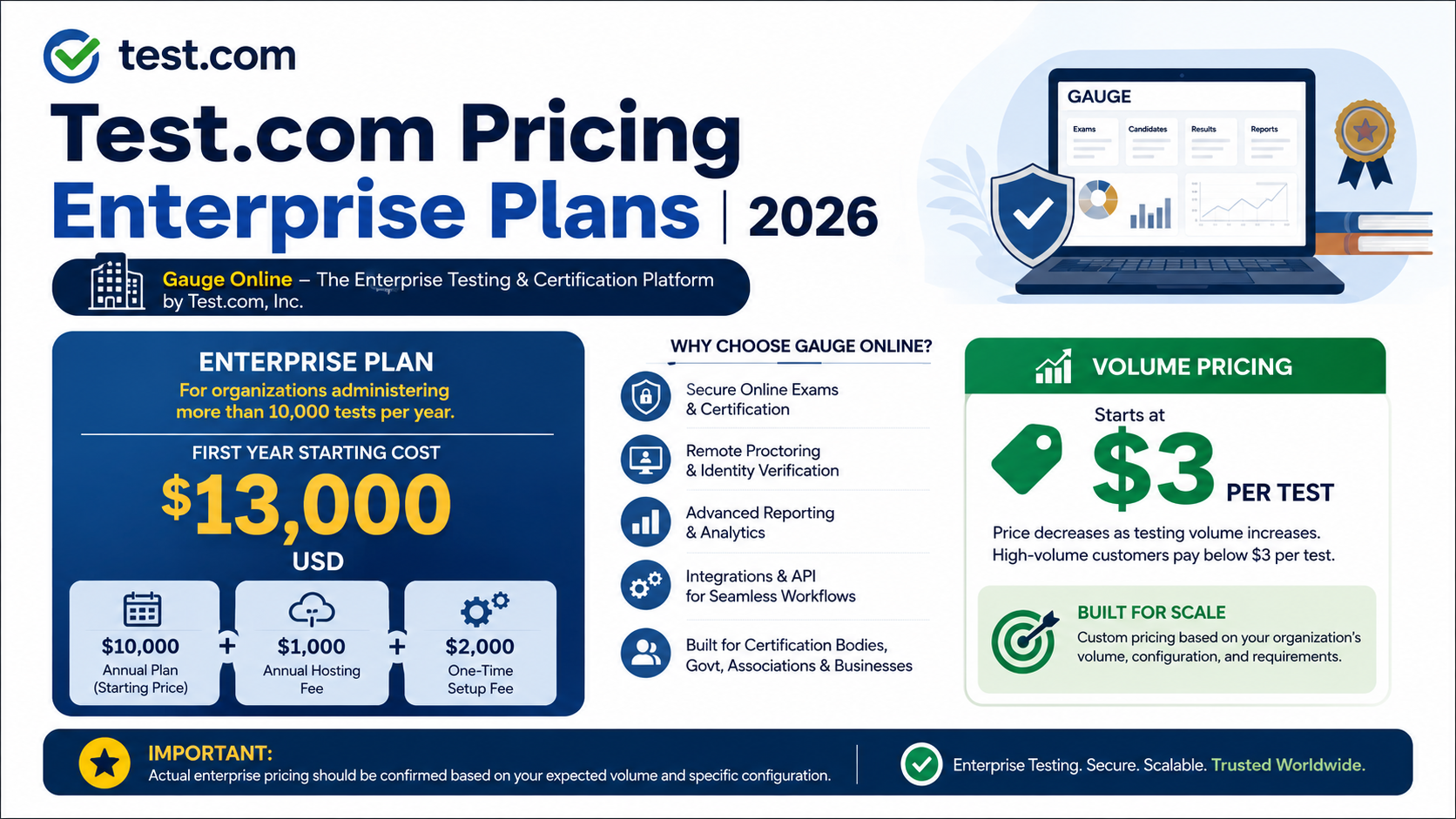
If you are researching Test.com Pricing Enterprise Plans, the most important point is that the relevant product is now presented as Gauge Online, the online testing and certification platform operated by Test.com, Inc. It is not simply a consumer quiz website. Gauge is built for professional certification bodies, government organizations, training providers, associations, and businesses that need controlled online exams, credentialing, proctoring, reporting, and integrations.
The current published Enterprise starting price is $10,000 per year, plus $1,000 annual hosting and a $2,000 one-time setup fee. That produces a published first-year starting cost of $13,000, before any other requirements or negotiated arrangements. Enterprise is intended for organizations administering more than 10,000 tests per year.
The pricing is therefore better understood as an enterprise testing-platform model rather than a conventional per-user SaaS subscription. Gauge also states that Enterprise volume pricing starts at $3 per test and decreases as testing volume increases, with its highest-volume customers paying below that level. Actual enterprise pricing should be confirmed against the organization’s expected volume and configuration.
What Is Test.com Today?
Test.com, Inc. operates the Gauge Online platform, which provides online test delivery and certification management for organizations that need more sophisticated assessment infrastructure than a basic quiz builder.
Gauge supports the broader testing lifecycle: creating assessments, managing question banks, delivering exams, controlling attempts and scoring, handling certification and badging, integrating proctoring, supporting lessons, and connecting the testing environment with external systems.
The company describes Gauge as a customizable platform for enterprises, complex organizations, and businesses that need greater control over training and certification programs. Its current positioning is particularly focused on professional certification and credentialing rather than ordinary consumer quizzes.
That distinction matters when evaluating the price. A $10,000 starting enterprise package would be difficult to justify for an organization that only needs occasional employee quizzes. It makes considerably more sense when testing is a central operational process involving thousands of candidates, formal credentials, security requirements, or integrations.
Test.com Pricing Enterprise Plans in 2026
Gauge currently presents two main pricing levels: Professional and Enterprise. The company bases pricing partly on annual exam volume and allows organizations to add functionality according to their requirements.
Current Published Pricing
+ $250 annual hosting
+ $500 one-time setup
Designed for growing credentialing programs.
+ $1,000 annual hosting
+ $2,000 one-time setup
Designed for organizations requiring more than 10,000 tests annually.
Published starting prices. Additional requirements, services, and negotiated volume arrangements can affect the final enterprise cost.
The Professional plan starts at $750 annually, with $250 for hosting and a $500 one-time setup charge. Enterprise starts at $10,000 annually, with $1,000 hosting and $2,000 for setup.
This means the Enterprise headline price should not be interpreted as a $10,000 all-in first-year contract. Using the currently published components, the starting first-year figure is $13,000.
How Does Enterprise Pricing Work?
The most important difference between Gauge and a simple subscription service is that Enterprise pricing is tied to the scale and requirements of the testing program.
Gauge states that organizations conducting more than 10,000 tests annually move into volume-based Enterprise pricing. The company says volume pricing starts at $3 per test and decreases as volume rises. It also says its highest-volume customers pay well below $3 per test.
Those statements should be treated as vendor-published pricing guidance, not as a guaranteed price for every customer. The final amount can depend on the organization’s testing volume, implementation requirements, selected capabilities, and agreement with the provider.
For that reason, companies comparing enterprise testing platforms should request a written quote based on their actual annual exam volume rather than assuming that $10,000 is their final annual bill.
What Is Included in the Enterprise Plan?
Gauge lists several capabilities specifically with its Enterprise offering, including:
- Certification and badging
- Proctoring integration
- Lessons
- eCommerce capability
- Developer tools and integrations
- Support for organizations administering more than 10,000 tests annually
The value of these features becomes clearer when testing is connected to a complete credentialing process.
For example, a professional association may need to register candidates, administer a high-stakes examination, verify results, issue a credential, collect payments, and maintain renewal information. Having these functions connected can reduce the need to operate several disconnected systems.
Testing and Exam-Building Capabilities
Gauge is considerably more configurable than a basic online form or quiz application.
Its current testing platform supports multiple exam formats, including basic tests, question-bank exams, and section-based exams. Administrators can configure time limits, attempt limits, passing thresholds, scoring rules, hints, media, and other exam parameters.
Question banks are another important feature for larger programs. Organizations can reuse question pools across exams and randomly select questions, which can help create different exam instances while maintaining control over the underlying assessment content.
Bulk question uploading can also reduce administrative work when migrating an existing question library into the platform.
For certification organizations, these capabilities are more relevant than cosmetic interface features because exam integrity, repeatability, and controlled assessment rules can directly affect the credibility of a credential.
Enterprise Integrations and Technical Controls
One of the stronger arguments for the Enterprise plan is its integration capability.
Gauge’s Enterprise information describes support for REST API, webhooks, and SSO, allowing organizations to connect the testing platform with existing systems. The company specifically discusses integration with systems such as learning-management and CRM platforms.
The platform also provides controls for authentication and access. Its documentation describes options including custom authentication preferences, IP-based access restrictions, and referral-address restrictions.
These capabilities are particularly relevant for organizations that already have an established technology stack.
An enterprise customer should nevertheless test the actual integration requirements during evaluation. “API available” is not the same thing as “every desired workflow is available without development.”
Proctoring and Exam Security
Proctoring is another important part of the enterprise proposition.
Gauge supports integrations with remote proctoring providers and offers GaugeLive for on-site proctored testing. The platform can also accommodate different purchasing arrangements, including situations where the organization purchases proctoring or the test taker pays for it.
This can be useful for professional certification, licensing, compliance, and other high-stakes assessments where an organization needs stronger controls than an ordinary online quiz.
However, buyers should distinguish between proctoring integration and the total cost of proctoring. The platform may connect the exam workflow to a proctoring service, but the cost structure of the proctoring component should be evaluated separately.
Does Test.com Offer a Free Trial?
Yes. Gauge currently advertises a 30-day free trial with no credit card required. Its trial information also describes a guided evaluation process for organizations considering the platform.
For enterprise buyers, a trial is most useful when it is treated as a technical evaluation rather than simply a tour of the interface.
A serious evaluation should involve the people who will actually operate the certification program. They should test question-bank management, candidate workflows, reporting, authentication, integrations, proctoring, credential issuance, and data export before making a purchasing decision.
Who Is the Enterprise Plan Really For?
The Enterprise plan is best suited to organizations where online assessment is a significant business or operational function.
Gauge identifies use cases including government agencies, trade associations, credentialing bodies, professional certification programs, continuing education providers, and corporate training environments.
It is particularly compelling when an organization has several of the following characteristics:
- More than 10,000 tests per year
- High-stakes or regulated examinations
- Formal certification or credentialing
- Large candidate populations
- Remote or on-site proctoring requirements
- LMS, CRM, HR, or other system integrations
- Need for detailed administrative controls
- Online payment or eCommerce requirements
- Multiple languages or international candidates
A small company running a few hundred internal quizzes is a different case. Such an organization would likely need to compare the Professional tier or simpler assessment software before considering Enterprise.
Test.com Pricing Enterprise Plans: Strengths and Weaknesses
Strengths
Transparent starting price: Gauge publishes its Enterprise starting software cost, hosting charge, and setup fee instead of hiding the entire pricing model behind a sales call.
Designed for certification: Certification, badging, testing, proctoring, and renewal-related workflows make the platform more specialized than ordinary quiz software.
Strong configuration: Administrators have control over question banks, test structure, attempts, timing, scoring, and other exam settings.
Integration options: REST API, webhooks, and SSO can make Gauge more practical for organizations with existing business systems.
Proctoring support: The platform can connect testing with remote and on-site proctoring workflows.
Weaknesses
The headline Enterprise price is only a starting point: $10,000 is not necessarily the final annual cost.
First-year costs are higher than the headline: Hosting and setup bring the published first-year starting figure to $13,000.
Additional services need separate consideration: Proctoring, integrations, payment processing, implementation work, and other requirements may affect total expenditure.
Potential learning curve: A highly configurable certification platform can require more training and administration than a simple quiz application.
May be excessive for basic testing: Organizations that only need occasional employee assessments may not benefit enough from enterprise-level certification infrastructure to justify the investment.
How Does Gauge Compare With a Basic Quiz Platform?
The most useful comparison is not simply “expensive versus cheap.” It is basic assessment software versus certification infrastructure.
A lightweight quiz platform may be easier to deploy and less expensive for simple tests. Gauge becomes more interesting when the organization needs a combination of controlled examinations, question banks, certification, proctoring, reporting, payment capabilities, and integrations.
In other words, the Enterprise plan is primarily selling operational depth and control, not merely a place to publish multiple-choice questions.
What Should Buyers Calculate Before Purchasing?
Organizations should avoid evaluating the Enterprise plan solely on the $10,000 starting figure.
A better approach is to calculate total cost of ownership over at least several years.
The most useful question is therefore not “Can we afford $10,000?” It is “What will it cost us to operate the entire certification program with this platform compared with our alternatives?”
That calculation can reveal value that a simple subscription-price comparison misses.
Company Background and Track Record
Gauge says it has supported certification programs for more than 25 years. Its current company history identifies 1999 as its founding year, followed by certification-related feature development, enterprise security expansion, and a rebrand to Gauge in 2020.
The company currently identifies itself as Test.com, Inc., and the Gauge website carries that corporate attribution.
Gauge also publishes substantial historical usage figures. Its current About page states that the platform has delivered more than 17 million exams and served more than 1,000 testing bodies, while supporting 26 languages. These are company-reported figures rather than independently audited statistics, so they are best viewed as the provider’s own description of its scale.
That long operating history is relevant for organizations that do not want to move their certification program between providers every few years. At the same time, longevity alone should not replace technical due diligence.
Privacy, Data and Account Considerations
Organizations handling examination and certification information should examine the contractual and privacy terms before signing an enterprise agreement.
Gauge’s terms state that applicable clients have access to and own information and test responses submitted to the platform, subject to the applicable terms and privacy provisions.
For an enterprise implementation, buyers should specifically review data retention, account access, administrative permissions, audit requirements, data exports, integration security, and contractual responsibilities.
Payment processing deserves similar attention. Gauge supports payment integrations such as Stripe and PayPal for organizations that charge candidates, and its documentation states that payment-card information is not stored in Test.com’s databases when those services are used.
These details should still be checked against the current contractual setup chosen by the customer.
Is Test.com Legit?
The evidence supports treating Test.com/Gauge as an established commercial testing-software provider rather than an anonymous or newly created website.
The platform publicly identifies Test.com, Inc., publishes product and pricing information, maintains extensive documentation, provides a free trial, and describes a long history in online testing and certification.
That does not mean every customer experience will be identical, nor does it mean the platform will automatically be the right choice for every organization. Enterprise buyers should still evaluate the contract, security requirements, support arrangements, integrations, and total cost before committing.
Who Should Choose Professional Instead of Enterprise?
Professional deserves serious consideration when an organization is still below the Enterprise volume threshold or does not need the larger program capabilities.
Gauge currently positions Professional toward growing credentialing bodies and provides eight usage-based pricing levels. Its starting price is substantially lower than Enterprise, although additional modules and actual exam volume can change the final amount.
A smaller organization should therefore ask:
Do we actually need more than 10,000 tests annually?
Do we need enterprise integrations, certification and badging, proctoring, lessons, and eCommerce?
Would Professional plus selected modules satisfy our requirements?
If the answer to most of these questions is no, Enterprise may be unnecessary.
Who Should Consider Enterprise?
Enterprise becomes easier to justify when the testing program has reached a scale where manual administration and disconnected systems create meaningful operational costs.
Organizations with tens of thousands of annual assessments, formal professional credentials, complex exam rules, multiple integrations, and high-stakes security requirements are the clearest candidates.
For these buyers, the Enterprise plan is less about buying “more tests” and more about consolidating the infrastructure surrounding those tests.
Final Verdict on Test.com Pricing Enterprise Plans
The current Test.com Pricing Enterprise Plans picture is relatively clear: Gauge Online lists Enterprise starting at $10,000 per year, with $1,000 annual hosting and a $2,000 one-time setup fee. Based strictly on those published components, the first-year starting point is $13,000.
Gauge positions Enterprise for organizations conducting more than 10,000 tests annually and says volume pricing begins at $3 per test and declines as volume grows. The final price, however, should be treated as organization-specific rather than assuming the published starting figure is a universal enterprise rate.
The strongest reasons to consider the platform are its certification-oriented design, advanced exam configuration, question banks, proctoring options, credentialing, integrations, SSO, API and webhook capabilities, and broad administrative control.
The biggest limitation from a purchasing perspective is that the headline Enterprise price does not answer the entire budgeting question. Exam volume, implementation, proctoring, integrations, and other requirements need to be evaluated separately.
Overall, Gauge looks most appropriate for established certification, credentialing, training, and high-volume assessment programs—not organizations looking for a basic quiz tool. For a smaller program, Professional should be evaluated first. For a large organization already exceeding 10,000 annual tests, Enterprise is a reasonable platform to put through a serious technical and commercial comparison.
Frequently Asked Questions
How much does the Test.com Enterprise plan cost?
Gauge currently lists Enterprise at $10,000 per year, plus $1,000 annual hosting and a $2,000 one-time setup fee. The resulting published first-year starting figure is $13,000.
Who is the Enterprise plan designed for?
It is designed for large-scale certification programs and organizations requiring more than 10,000 tests per year.
Does Enterprise pricing include hosting?
No. Gauge separately lists $1,000 per year for hosting on top of the $10,000 Enterprise software starting price.
Is there a setup fee?
Yes. The current published Enterprise pricing lists a $2,000 one-time setup fee.
Does Gauge offer volume-based Enterprise pricing?
Yes. Gauge says Enterprise volume pricing starts at $3 per test and decreases as volume increases. The actual price should be confirmed through a customized quote.
Does Gauge support proctored exams?
Yes. Gauge supports remote proctoring integrations and provides GaugeLive for on-site proctored testing.
Does Gauge have a free trial?
Yes. Gauge currently advertises a 30-day free trial without requiring a credit card.
Is Test.com the same thing as Gauge Online?
Gauge Online is the current testing and certification platform associated with Test.com, Inc. The Gauge website identifies Test.com, Inc. as the company behind the platform.
Is the $10,000 Enterprise price the final amount a customer will pay?
Not necessarily. It is a published starting price. Exam volume, implementation requirements, additional services, and negotiated enterprise arrangements can affect the final cost.
Also Read: 5StarsStocks.com Materials Review | What the Site Actually Offers

1 Comment
Pingback: TozyMagazine.com USA Review | What Tozy Magazine Actually Offers in 2026