

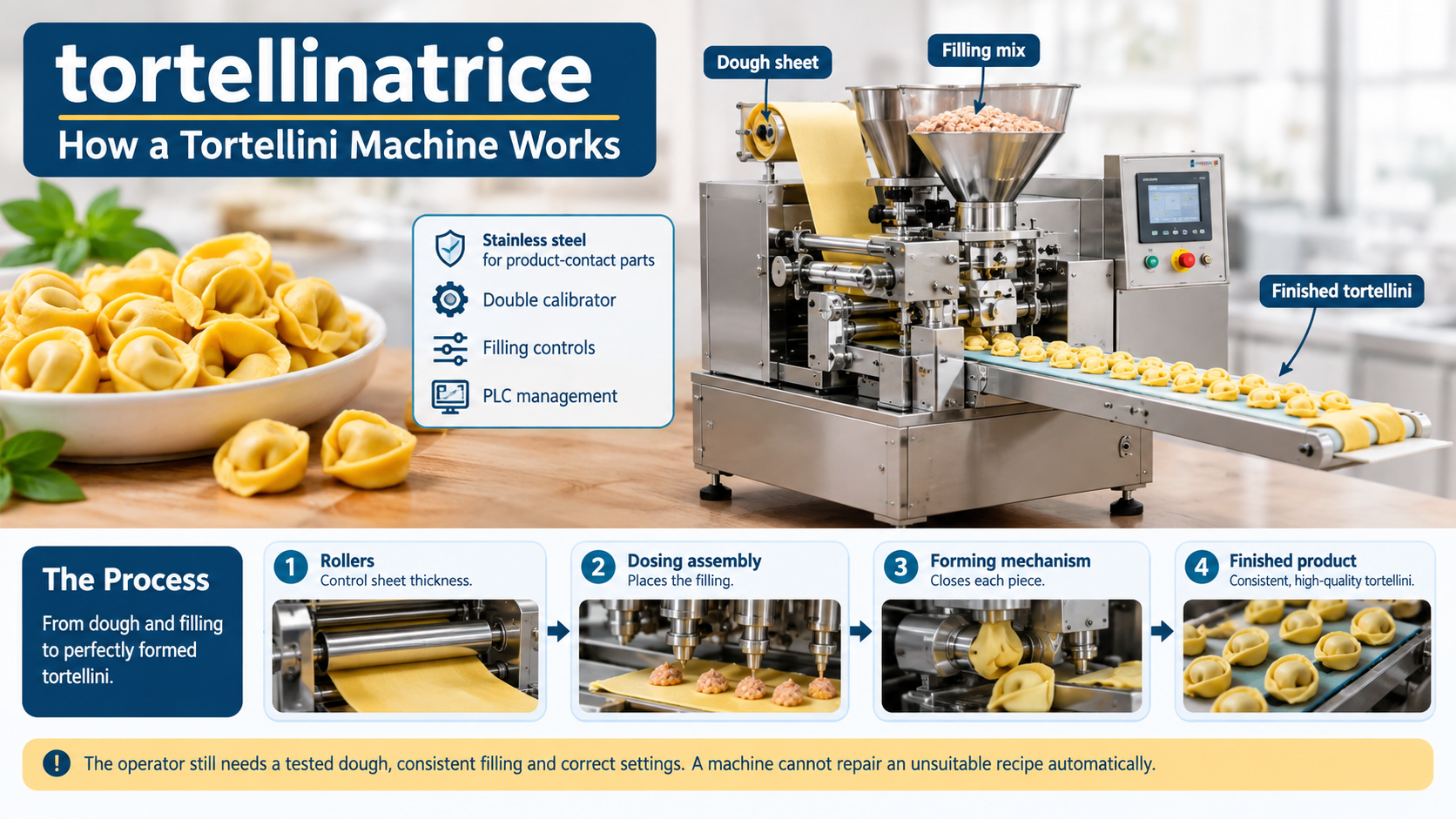
tortellinatrice is the Italian name used for a machine that forms tortellini. Professional models feed pasta sheets and filling into a forming system that portions, seals, cuts and shapes repeated pieces. Capacity and controls vary greatly, so buyers should judge a specific model rather than the name alone.
What is a tortellinatrice?
A tortellinatrice is specialised filled-pasta equipment. It is more focused than a basic roller, which only makes sheets. For example, Facchini’s TA540-S description specifies stainless steel for product-contact parts, a double calibrator, filling controls and PLC management.
Commercial machines may accept prepared dough sheets and a separate filling mix. Rollers control sheet thickness, a dosing assembly places filling, and the forming mechanism closes each piece. The operator still needs a tested dough, consistent filling and correct settings. A machine cannot repair an unsuitable recipe automatically.
How the machine forms tortellini
- The dough is mixed and converted into an even sheet.
- The sheet enters calibrated rollers at the required thickness.
- A measured portion of filling is deposited.
- The machine cuts, folds and seals the dough around it.
- Finished pieces are collected for cooking, chilling, freezing or packaging.
Individual designs differ. Ostoni’s T8 listing, for instance, describes an eight-punch automatic machine for medium Bologna-style pieces, with adjustable filling dose and sheet thickness. Those details belong to that model and should not be applied to every tortellini machine.
Production size and machine choice
Start with the required finished pieces per hour, but also examine the entire line. ANKO presents automated tortellini production as a system that can include forming, planning and recipe support. A high forming speed is of limited value when dough preparation, chilling or packaging cannot keep pace.
| Requirement | Question to ask |
|---|---|
| Product | Which size, weight and shape can the mould make? |
| Filling | What texture and particle size can the doser handle? |
| Cleaning | Which food-contact parts can be removed and sanitised? |
| Capacity | Is output stated for the exact product and recipe? |
| Support | Are training, spares and local service available? |
Home tools are not the same product
A cutter set or pasta roller can help a home cook make tortellini, but it is not necessarily an automatic tortellinatrice. Marcato’s Tortellini Like a Pro set, for example, includes cutters and guidance rather than an industrial depositing and forming line.
This distinction matters when comparing prices. A manual accessory, countertop appliance and factory machine solve different problems. Request a demonstration using your intended dough and filling before buying production equipment.
Safety, cleaning and testing
Ask the supplier for the operating manual, electrical requirements, guarding details and cleaning procedure. Confirm which surfaces contact food and whether allergens can be removed between recipes. Train staff to isolate power before maintenance and follow the manufacturer’s instructions rather than generic online advice.
Run a controlled trial. Measure piece weight, seal failures, filling loss, changeover time and cleaning time. These results provide a more useful comparison than advertised maximum speed alone.
Frequently asked questions
Does a tortellinatrice make the dough?
Not always. Many forming machines require a prepared sheet or upstream dough equipment.
Can it make ravioli?
Only if the manufacturer provides a compatible forming system or separate attachment.
Is stainless steel enough to prove food safety?
No. Design, cleaning, materials, operation and local compliance all matter.
What should a buyer test first?
Test the actual recipe, desired piece size, seal quality and achievable line output.
Sources
Specifications were checked against the named Facchini, Ostoni, ANKO and Marcato product pages. Model-specific claims have not been generalised.
Related reading on checking technical claims before relying on them: thealitekeepsafe.com: What the Site Covers and How to Assess It.
