

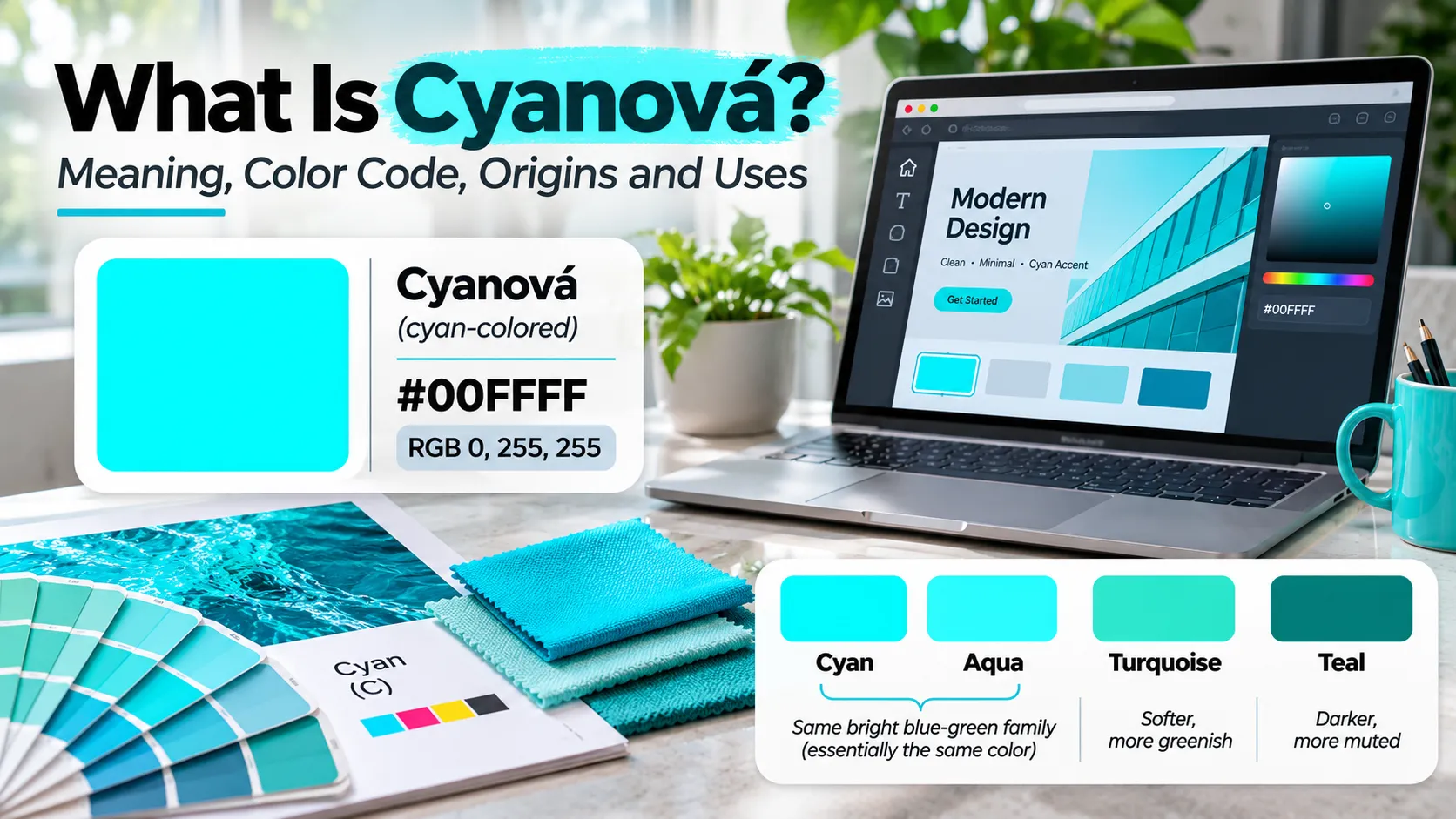
Cyanová is a Czech color adjective meaning “cyan-colored.” It describes something with a cyan or blue-green appearance, rather than a newly discovered color with its own official specification. The familiar digital cyan color has the HEX code #00FFFF, but that value does not automatically define every shade described as Cyanová.
Its accented spelling can look unfamiliar to English readers. Separating the linguistic meaning from color specifications makes the term easier to understand.
What Does Cyanová Mean?
In Czech, adjectives often change their endings to agree with the grammatical gender of the noun they describe. Cyanová is a feminine form associated with cyan. In the phrase cyanová barva, it describes a cyan color; barva means “color” and is grammatically feminine.
The usage predates recent online articles. Ivan Dylevský used the phrase cyanová barva in a 2005 Czech academic article, Barvy, barevné vnímání a koloroterapie, published through the University of South Bohemia. The paper links an older Greek term, kyaneos, to the Czech expression.
For an English audience, cyan is normally the clearer choice. Cyanová is useful when translating Czech material, explaining foreign-language color terminology, or quoting a specific color description. Its distinctive spelling should not be mistaken for evidence of an entirely different hue.
Is Cyanová a Separate Color?
There is no separate CSS named color called cyanová in the World Wide Web Consortium’s color specification. The standard lists cyan, alongside related names such as aqua, turquoise, and teal.
That distinction matters because a color name and an exact color specification are not the same thing. Someone might describe a pale blue-green fabric as cyan-colored, while a developer uses a precisely defined cyan value in a website. Only the numerical code fixes the intended digital color.
Claims that Cyanová is a newly established scientific color, a universally recognized pigment, or a formal design movement need independent evidence. The documented Czech meaning alone supports none of those claims.
What Is the Cyanová HEX and RGB Code?
When someone asks for the Cyanová color code, they usually want a reference for cyan. In standard CSS, the values for pure cyan are:
- HEX:
#00FFFF - RGB:
rgb(0, 255, 255) - CSS keyword:
cyan
HEX notation stores red, green, and blue channel values in hexadecimal format. RGB expresses those same components as numbers from 0 to 255. For pure cyan, red is zero while green and blue are at their maximum values.
However, #00FFFF is the standard code for cyan, not an independently assigned official Cyanová code. If a designer labels a softer or darker shade Cyanová, ask for its exact HEX or RGB value rather than assuming it matches pure cyan.
Cyanová vs Cyan, Aqua, Turquoise and Teal
These related color names are sometimes used loosely in conversation. In CSS, however, they have defined values:
| CSS color | HEX code | Appearance |
|---|---|---|
| Cyan | #00FFFF | Bright blue-green |
| Aqua | #00FFFF | Identical to cyan in CSS |
| Turquoise | #40E0D0 | Softer, greener blue-green |
| Teal | #008080 | Darker, muted blue-green |
Cyan and aqua are exactly the same CSS color, despite having different names. Turquoise is a separate, less intense reference shade, while teal is considerably darker. The codes are more reliable than informal labels.
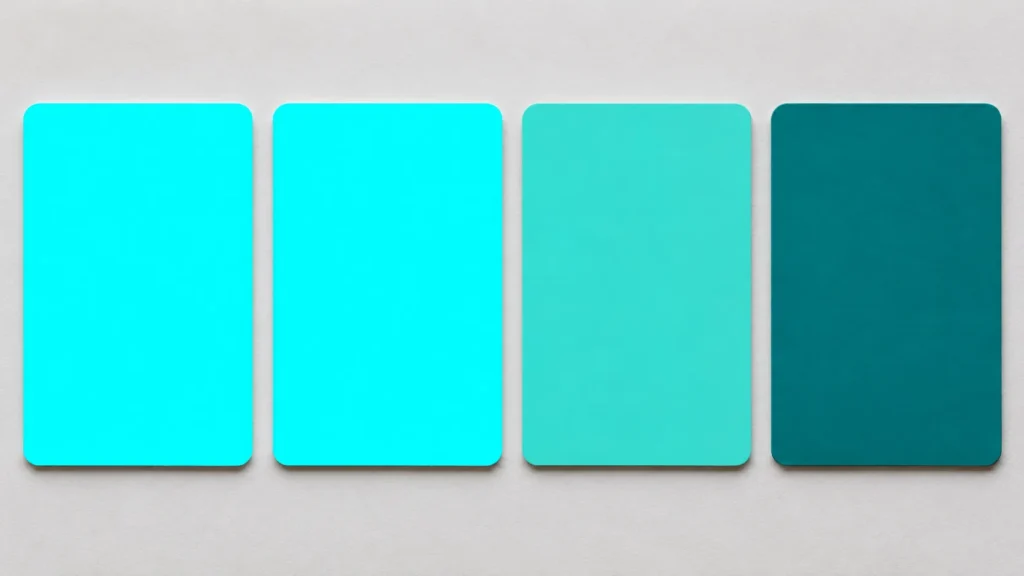
Cyanová does not occupy a new official position between these colors. It is a word used to describe cyan-related coloring, so its appearance depends on the context and the particular shade being discussed.
How Can Cyan-Inspired Colors Be Used in Design?
Cyan can work as an accent in website interfaces, diagrams, posters, illustrations, and brand palettes. Its brightness makes it noticeable against dark navy or charcoal backgrounds. A more subdued turquoise or teal may be easier to incorporate into larger surfaces.
For web design, choose a specific color value and use it consistently in buttons, illustrations, borders, and supporting graphics. Avoid relying only on the label “cyanová,” especially when multiple people or design tools need to reproduce the same shade.
Check Text Contrast Before Publishing
Bright cyan text can be difficult to read on a white background. The W3C’s WCAG accessibility guidance specifies a contrast ratio of at least 4.5:1 for regular text and 3:1 for qualifying large text, with defined exceptions. Check your actual foreground and background colors rather than judging readability by appearance alone.
Expect Differences Between Screens and Print
Digital RGB colors are created with light; CMYK printing uses cyan, magenta, yellow, and black inks. A vivid screen color may change when converted for a printer because its printable color range is different. Adobe recommends using the appropriate output profile and checking the conversion before commercial printing.
A printed result also depends on paper, ink, and the printing process. For important brand materials, request a physical proof instead of assuming that a HEX code will reproduce identically on paper.

Why Do Online Definitions of Cyanová Differ?
Some articles describe Cyanová as a shade, others as an aesthetic, and others simply as a translated word. These explanations are not interchangeable. The Czech-language usage is documented, and cyan’s technical values are established. A broader cultural label would require separate evidence identifying who uses it and what it means.
Without the accent, Cyanova may also name unrelated projects. Those results should not be confused with the color adjective.
FAQs
Is Cyanová a real word?
Yes. Its use in Czech color terminology is documented, including the phrase cyanová barva in a 2005 academic publication. That does not make it a separate standardized English color name.
Does Cyanová have an official HEX code?
No distinct universal code was established. Pure digital cyan is #00FFFF, but a particular object or design described as Cyanová may use a different blue-green shade.
Are cyan and aqua the same color?
In CSS, yes. Both named colors correspond to #00FFFF, or RGB (0, 255, 255). Their names differ, but the displayed value is the same.
Can I use Cyanová as a brand color?
Yes, as a creative name or descriptive label. For consistent branding, specify the exact HEX, RGB, or print color reference in your style guide.
Will cyan look the same when printed?
Not necessarily. Printers have different color capabilities, and paper or ink choices can change the result. Use suitable color profiles and printed proofs for work requiring close color matching.
Also, Read: LCFTechMods Gaming Update by LyncConf
