

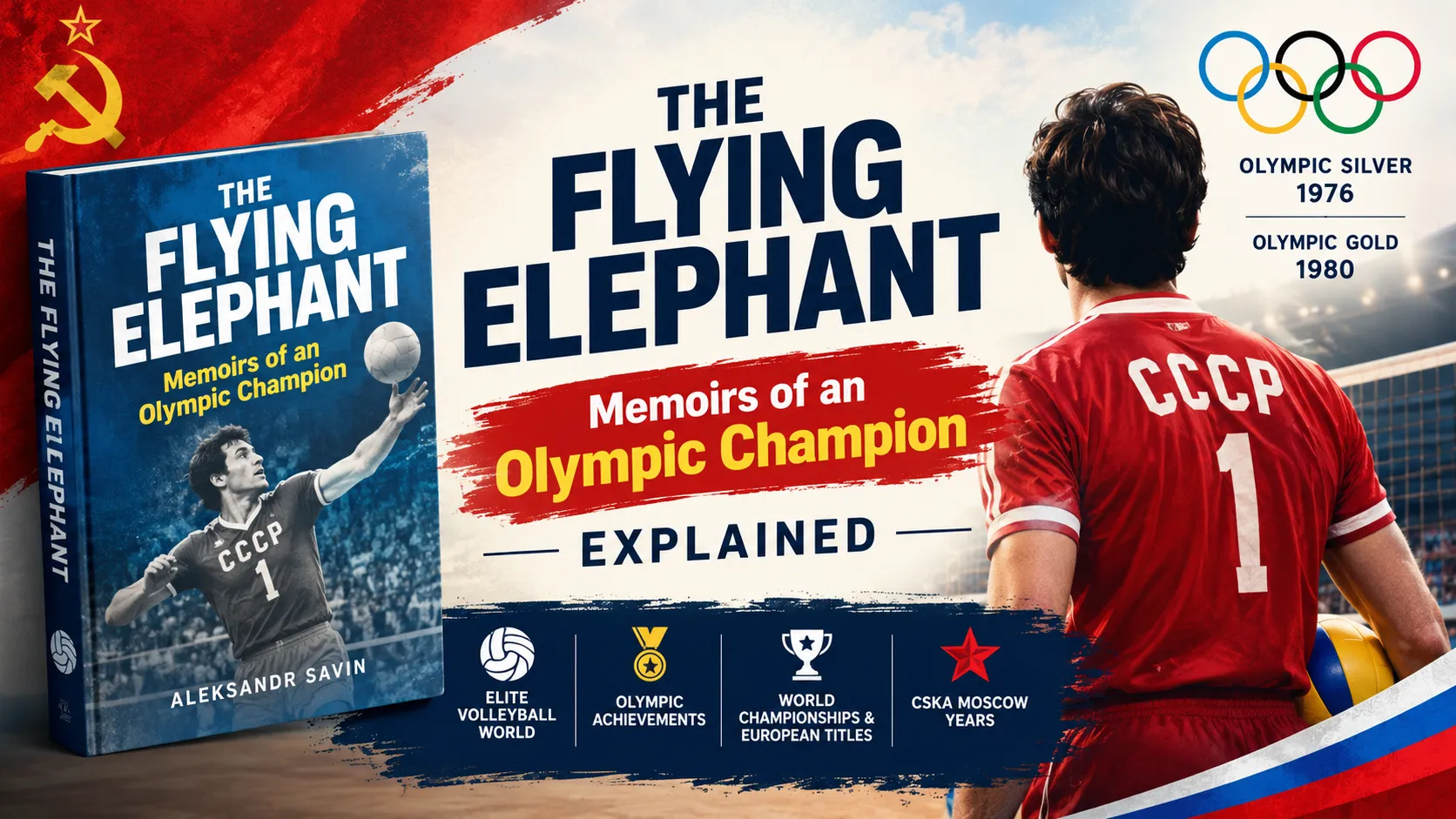
The Flying Elephant: Memoirs of an Olympic Champion is a sports memoir associated with Aleksandr (Alexander) Savin, a celebrated Soviet volleyball player who won Olympic silver in 1976 and Olympic gold in 1980. The book explores the world of elite volleyball and offers readers a way to learn about the athlete behind those achievements, although details about the English edition should be checked against its current book listing.
Savin’s story is particularly interesting because his career unfolded during a highly successful period for Soviet volleyball. His achievements extended beyond the Olympic Games to world championships, European titles, and years of competition with CSKA Moscow. Understanding his sporting background helps explain the historical significance of The Flying Elephant: Memoirs of an Olympic Champion.
What Is The Flying Elephant: Memoirs of an Olympic Champion?
The Flying Elephant: Memoirs of an Olympic Champion is presented online as a memoir of Aleksandr Savin’s life and volleyball career. Descriptions of the English-language edition identify it as a Kindle book and discuss its connection to Soviet-era volleyball, international tournaments, and the people who shaped Savin’s sporting journey.
However, there is an important distinction between information about the book and independently verified facts about its publication. Savin’s Olympic achievements and career are documented by established volleyball institutions, while some specific details about the English edition, including its publication information, page count, and photographic content, require confirmation from a reliable retailer or publisher record.
That distinction matters to readers researching an unfamiliar title. A book description can explain the intended subject, but its claims about format, contents, and publication history should not automatically be treated as independently established facts.
Who Is Aleksandr Savin?
Aleksandr Borisovich Savin was born on July 1, 1957, in Taganrog, in what is now Russia. He became one of the leading players in Soviet men’s volleyball, represented the Soviet Union at two Olympic Games, and was inducted into the International Volleyball Hall of Fame in 2010.
Savin played as a middle blocker, a position that demands effective blocking at the net, quick reactions, and well-timed attacking movements. He also played for CSKA Moscow from 1973 to 1988, according to the club’s official profile. His career is a useful lens through which to understand the demands and achievements of elite volleyball during the late twentieth century.
His accomplishments were not limited to one Olympic tournament. The CSKA profile records world championship titles, World Cup victories, European Championship wins, and numerous Soviet club championships. Those results establish why Savin’s career remains relevant to volleyball history.
Alexander Savin’s Olympic Journey
The Olympic Games provide the clearest framework for understanding Savin’s reputation. His first Olympic appearance ended with a silver medal, while his second brought the Soviet team the gold medal in front of a home crowd in Moscow.
Montreal 1976: Winning Olympic Silver
At the 1976 Summer Olympics in Montreal, Savin competed for the Soviet men’s volleyball team. The Soviets progressed through the pool stage and reached the gold-medal match, but Poland won the final in five sets, leaving the Soviet team with silver. The International Volleyball Hall of Fame documents Savin’s participation and the result.
The result was an important milestone in Savin’s early international career. Olympic competition brought together the world’s strongest national teams, making the tournament a demanding test of technical ability, tactical discipline, and performance under pressure.
For readers interested in the memoir, Montreal provides historical context for the athlete’s development. It represents a major achievement, but also a reminder that reaching the Olympic final does not guarantee victory.
Moscow 1980: Becoming an Olympic Champion
The 1980 Moscow Olympics marked the high point of Savin’s Olympic career. Playing for the Soviet Union on home soil, he helped his team win the gold medal after a successful tournament, including a 3–1 victory over Bulgaria in the final.
The victory secured Savin’s place among Olympic champions. It also formed part of a wider period of success for Soviet volleyball, with the national team winning major international competitions during the 1970s and 1980s.
The difference between the two Olympic experiences is significant. Montreal brought the disappointment of a close final, while Moscow delivered the ultimate result in international sport. Together, the tournaments illustrate the competitive journey behind Savin’s Olympic record.
What Does The Flying Elephant Memoir Cover?
The book is presented as a personal account of Savin’s sporting life, with an emphasis on volleyball, Olympic competition, and the people who contributed to his success. Online descriptions also associate it with memories of Soviet volleyball and reflections on teammates, coaches, and the wider sporting community.
Because a complete, independently verified table of contents was not available in the sources reviewed, it would be premature to claim that every subject mentioned in online descriptions appears in the published book. The following themes provide useful context for understanding the memoir and the career on which it is based.
Life Inside Soviet Volleyball
Savin’s career developed within a sports system in which national teams and major clubs competed for international recognition. CSKA Moscow was central to his playing career, while the Soviet national team provided the stage for his Olympic and world championship achievements.
This historical setting makes the memoir potentially interesting beyond its central subject. Readers can use Savin’s career to explore how elite volleyball operated during the Soviet era, including the importance of national-team preparation, club competition, and sustained international performance.
It is important, however, to distinguish historical context from the book’s precise contents. Without a verified full text, individual anecdotes or detailed claims about internal training practices should not be attributed to Savin’s memoir as confirmed quotations or passages.
Teamwork and the Importance of Coaches
Volleyball is a team sport in which individual ability must work within a coordinated system. A middle blocker depends on timing, communication, positioning, and the decisions of teammates, particularly the setter and other front-row players.
Savin’s international record illustrates this collective dimension of achievement. His Olympic medals were won as part of the Soviet team, and the Hall of Fame’s account of his career places his results within the team’s broader development.
For readers interested in sport, this provides a practical perspective on success. Individual talent matters, but a champion’s results also depend on preparation, trust, tactical decisions, and the ability to perform consistently alongside other athletes.
The Challenges Behind Olympic Success
Olympic medals represent the visible result of years of preparation. Athletes must maintain physical conditioning, learn complex tactical systems, and perform when the outcome of a tournament can depend on a small number of points.
Savin’s progression from silver in Montreal to gold in Moscow gives this subject a concrete historical example. It demonstrates how a career can contain both disappointment and achievement, without requiring the athlete’s story to be reduced to a single victory.
Readers should not assume that the memoir provides a particular psychological analysis or detailed account of personal struggles unless those passages can be confirmed from the book itself. The broader themes of pressure, persistence, and teamwork are relevant to Savin’s sporting history, but precise descriptions of his private experiences require direct evidence.
Why Is the Book Called The Flying Elephant?
The title The Flying Elephant is unusual because it combines an image of weight and strength with the idea of flight. It naturally invites questions about its origin and significance, especially for readers who encounter the title without knowing Savin’s background.
However, the sources reviewed do not establish a definitive explanation for the title. It would be speculative to say that it refers to Savin’s physique, a particular playing technique, a nickname, or a specific incident in his career without a reliable source confirming that connection.
The safest approach is to treat the title as a distinctive part of the book’s identity rather than assign it a meaning that has not been verified. A foreword, introduction, or passage from the memoir could provide a more authoritative explanation.
How Was Alexander Savin’s Volleyball Career Recognized?
Savin’s achievements can be understood through his international medals and his long association with competitive volleyball. The official CSKA profile records his Olympic, world championship, World Cup, European Championship, and domestic club accomplishments.
| Achievement | Verified record |
|---|---|
| Olympic silver medal | Montreal, 1976 |
| Olympic gold medal | Moscow, 1980 |
| World Championship gold medals | 1978 and 1982 |
| World Cup titles | 1977 and 1981 |
| European Championship titles | 1975, 1977, 1979, 1981, 1983 and 1985 |
| CSKA Moscow playing career | 1973 to 1988 |
| International Volleyball Hall of Fame | Inducted in 2010 |
Source: CSKA’s official profile and the International Volleyball Hall of Fame.
These results show that Savin’s sporting reputation rests on sustained success rather than one Olympic appearance. Winning major international tournaments across several years required him to remain competitive as opponents, tactics, and tournament conditions changed.
From Player to Coach
Savin’s professional life also continued beyond his playing career. According to CSKA’s official biography, he worked as a head coach and held coaching positions with several teams after his playing career, including assignments in Madagascar and Russia. He later served as a Russian national-team state coach from 2005 to 2010.
This later chapter adds another dimension to his sporting legacy. A successful player may understand the technical demands of a match, but coaching requires communicating knowledge, developing athletes, and helping teams work toward common objectives.
For readers interested in the wider meaning of an athlete’s career, Savin’s move into coaching is a useful reminder that sporting contributions do not necessarily end when competitive playing does.
The English Edition and Where to Find the Book
Online descriptions identify an English-language Kindle edition of The Flying Elephant: Memoirs of an Olympic Champion. One website gives the author as Alexander Savin and lists Andrei Savine and Alfredo Cabero among the translators, with Julia Savine credited as an editor and Peter Murphy credited with an introduction.
These details come from online descriptions rather than an independently confirmed publisher catalogue in the sources reviewed. Readers should therefore check the current retailer listing before relying on the edition’s publication date, page count, language, contributors, or availability.
To investigate the book, start with the Flying Elephant memoir website and compare its information with the listing on the relevant Kindle marketplace. Confirm that the author and full title match before purchasing, since similar search phrases can lead to articles about different athletes or unrelated books.
The availability of a Kindle listing also does not automatically establish that the book is included in Kindle Unlimited, offered at a particular price, or available in every country. Those details can change by marketplace and over time.
Who Should Read The Flying Elephant: Memoirs of an Olympic Champion?
The book may appeal to several types of readers, particularly those interested in the history of international volleyball and the experiences of Olympic athletes.
- Volleyball fans who want to learn more about a prominent Soviet player and his competitive era.
- Sports historians researching the Soviet Union’s international volleyball achievements.
- Athletes and coaches interested in the demands of elite competition and the relationship between individual performance and teamwork.
- Olympic history readers who enjoy learning about the people behind major sporting events.
- Readers of sports memoirs who prefer accounts connected to real competitive careers rather than fictional stories.
Readers seeking a detailed account of the Soviet sports system may also find Savin’s career a useful starting point. However, they should distinguish the independently documented history of his achievements from any specific anecdotes that have not been verified in the memoir.
What Makes Alexander Savin’s Story Historically Important?
Savin’s importance rests on the combination of Olympic success, multiple international titles, and a long career with CSKA Moscow. His induction into the International Volleyball Hall of Fame in 2010 provides further institutional recognition of his place in the sport’s history.
His Olympic results also belong to a specific historical period. The Soviet men’s team was a major force in international volleyball, and Savin competed during years when European and world titles were important measures of sporting strength.
The memoir’s potential value lies in the possibility of bringing that history closer to readers through an athlete’s own perspective. Its value as a historical source ultimately depends on the quality of its firsthand material, the accuracy of its recollections, and how clearly its claims can be checked against established records.
Frequently Asked Questions
1. What is The Flying Elephant: Memoirs of an Olympic Champion about?
It is presented as a sports memoir associated with Aleksandr Savin, the Soviet volleyball player who won Olympic silver in 1976 and gold in 1980. Online descriptions connect the book with his career and the history of Soviet volleyball, although the complete contents have not been independently verified.
2. Who wrote The Flying Elephant: Memoirs of an Olympic Champion?
The English-language edition is attributed to Alexander Savin. Online descriptions credit Andrei Savine and Alfredo Cabero with translation work and list other editorial contributions, but readers should verify those credits against the current book listing.
3. Was Alexander Savin an Olympic champion?
Yes. Savin won a silver medal with the Soviet men’s volleyball team at the 1976 Montreal Olympics and a gold medal at the 1980 Moscow Olympics. His results are documented by the International Volleyball Hall of Fame.
4. What does the title The Flying Elephant mean?
A definitive explanation of the title has not been established by the reliable sources reviewed. Although the phrase suggests an unusual combination of strength and movement, connecting it to a particular nickname or event in Savin’s life would require further evidence.
5. Is The Flying Elephant available as a Kindle book?
An online description identifies an English Kindle edition, but availability and purchasing terms may vary by country and retailer. Check the current marketplace listing to confirm the edition, contributors, price, and reading options before buying.
6. Why is Alexander Savin important in volleyball history?
Savin was an Olympic gold medalist, a world champion, a multiple-time European champion, and a long-serving CSKA Moscow player. His induction into the International Volleyball Hall of Fame in 2010 recognizes his contribution to the sport.
Also Read: AICOT Explained: Meaning, Uses, Technology, and Key Facts
