

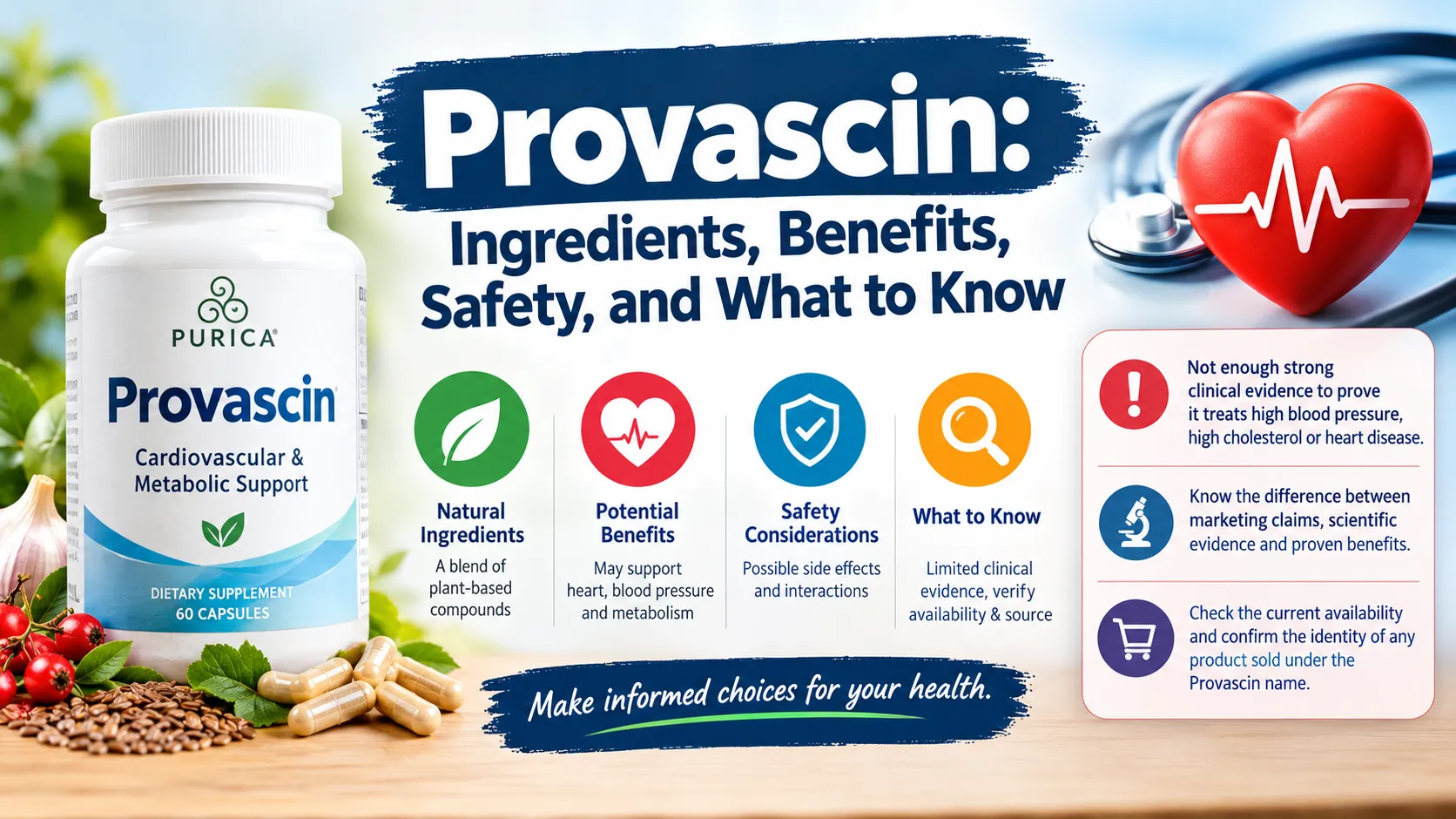
Provascin is best documented as a multi-ingredient dietary supplement historically sold under the PURICA brand for cardiovascular and metabolic support. Although its ingredients have been studied for various health-related effects, there is not enough strong clinical evidence to establish that the complete Provascin formula treats high blood pressure, high cholesterol, or heart disease.
Anyone researching Provascin should distinguish between the product’s historical marketing claims, the scientific evidence behind its individual ingredients, and proven medical benefits. Its current availability and the identity of any product being sold under the same name should also be verified before purchase.
What Is Provascin?
Provascin is the name of a historical nutritional supplement associated with PURICA, a Canadian natural health product brand. Older retail listings describe it as a capsule formula containing amino-acid-related compounds, antioxidants, and plant extracts intended to support cardiovascular health and normal metabolic functions.
The name can be confusing because some online articles describe Provascin as though it were a prescription heart medication. The available documentation supports identifying the established PURICA product as a supplement, not as a verified prescription cardiovascular drug.
| Product detail | What available records indicate |
|---|---|
| Product name | Provascin |
| Historical brand | PURICA |
| Product category | Nutritional or natural health supplement |
| Historical format | Capsules |
| Intended use | Cardiovascular and metabolic support |
| Current availability | Requires verification |
| Proven treatment for heart disease | Not established |
The distinction between supplements and medicines matters. A product marketed for heart health is not necessarily proven to prevent heart attacks, control blood pressure, or treat an existing cardiovascular condition.
What Ingredients Does Provascin Contain?
Historical retailer listings identify eight principal ingredients in the PURICA Provascin formula. The amounts below are reported per capsule in older product information and should not be assumed to apply to every product currently using the Provascin name.
| Ingredient | Historical amount per capsule | General role |
|---|---|---|
| L-carnitine | 188 mg | Involved in transporting fatty acids for energy production |
| Alpha-ketoglutaric acid | 125 mg | Participates in cellular energy metabolism |
| Micronized Chaga | 125 mg | Mushroom ingredient studied for various biological effects |
| Coenzyme Q10 (CoQ10) | 38 mg | Helps cells produce energy and supports antioxidant activity |
| Betaine hydrochloride | 31 mg | Source of betaine-related compounds; hydrochloride also affects stomach acidity |
| DL-alpha-lipoic acid | 13 mg | Compound involved in cellular energy metabolism and antioxidant processes |
| Grape seed extract | 9 mg | Contains polyphenols, including proanthocyanidins |
| Green tea extract | 9 mg | Contains tea-derived compounds, including catechins |
Historical listings also identify non-medicinal ingredients such as microcrystalline cellulose, hypromellose, and plant-source magnesium stearate. These are commonly used as capsule or manufacturing ingredients.
The presence of a scientifically studied ingredient does not automatically establish that a supplement is effective. The dose, formulation, quality, interactions between ingredients, and evidence from studies of the finished product all matter.
What Are the Potential Benefits of Provascin?
Provascin was marketed for cardiovascular wellness, circulation, antioxidant support, and metabolic health. These are intended uses rather than established outcomes, and research on the individual ingredients cannot confirm that the complete formula delivers those benefits.
1. Cardiovascular Support
CoQ10 and L-carnitine participate in cellular energy processes, including functions relevant to tissues with high energy demands, such as the heart. However, the biological importance of these compounds does not mean that taking a supplement containing them will necessarily improve heart function or prevent cardiovascular disease.
People with diagnosed heart conditions should rely on treatments supported by clinical evidence rather than using Provascin as a substitute for prescribed medication.
2. Antioxidant Activity
CoQ10, alpha-lipoic acid, grape seed extract, green tea extract, and Chaga are associated with antioxidant-related research. Antioxidants interact with compounds involved in oxidative stress, a process that has been studied in relation to several chronic diseases.
Nevertheless, laboratory evidence of antioxidant activity does not establish that a supplement prevents heart attacks, reverses arterial damage, or improves long-term health outcomes.
3. Cholesterol Management
Green tea extract has been studied for its effects on blood cholesterol. According to the US National Center for Complementary and Integrative Health (NCCIH), studies suggest that green tea products can produce small reductions in total and LDL cholesterol, although effects vary and this evidence does not establish that Provascin itself lowers cholesterol.
Anyone with high cholesterol should discuss evidence-based treatment options with a healthcare professional. A supplement should not replace a prescribed statin or another recommended treatment without medical advice.
4. Energy Metabolism
L-carnitine helps transport fatty acids into mitochondria, the structures inside cells that produce usable energy. Alpha-ketoglutaric acid and CoQ10 also have roles in cellular metabolism.
These functions help explain the historical ingredient selection, but they do not prove that Provascin increases everyday energy, improves exercise performance, or relieves fatigue in otherwise healthy people.
Does Provascin Lower Blood Pressure?
There is insufficient direct evidence to conclude that the complete Provascin formula reliably lowers blood pressure. Research involving individual ingredients or related supplement formulations cannot establish the effectiveness of this specific product.
Some studies have investigated green tea products for blood-pressure effects, but findings about an individual ingredient should not be treated as proof that a multi-ingredient supplement treats hypertension.
If you have high blood pressure, use a validated home monitor when recommended, follow your clinician’s treatment plan, and discuss any supplements before taking them. Do not stop or reduce blood-pressure medication because of claims made about Provascin.
Is Provascin Safe?
Provascin’s safety cannot be fully established from its historical ingredient list alone. Individual ingredients can have side effects, and risks depend on the actual formulation, amounts consumed, personal health conditions, and other medicines being taken.
The historical retailer listing specifically advised consultation with a healthcare practitioner for people with certain medical conditions and those taking particular medications.
Possible Side Effects
Potential concerns associated with some of the ingredients include:
- Digestive discomfort: Green tea extract can cause nausea, constipation, or abdominal discomfort.
- Liver problems: Rare cases of liver injury have been reported with concentrated green tea extracts, particularly in capsule or tablet form.
- Medication interactions: Green tea products can affect the levels of certain medicines, including nadolol and atorvastatin.
- Individual sensitivity: Herbal extracts and other supplement ingredients may cause unwanted reactions in some people.
These are ingredient-related safety considerations, not confirmed rates of side effects specifically caused by Provascin. The NCCIH provides further information on green tea extract safety and medication interactions.
Who Should Consult a Doctor Before Using It?
Speak with a doctor or pharmacist before using a Provascin product if you:
- Take prescription medicines, especially medicines for blood pressure, diabetes, cholesterol, or blood clot prevention.
- Have liver or kidney disease.
- Have an autoimmune condition or take immunosuppressant medication.
- Have a seizure disorder.
- Are pregnant or breastfeeding.
These precautions are particularly important when the exact product formulation or dose is uncertain.
Is Provascin FDA Approved?
There is no verified evidence in the sources reviewed that the historical PURICA Provascin is an FDA-approved prescription medicine. It is documented as a nutritional or natural health supplement.
The US Food and Drug Administration (FDA) explains that dietary supplements are regulated differently from prescription drugs. In the United States, the FDA does not generally approve dietary supplements for safety and effectiveness before they are marketed, although it can take action against products that are unsafe or violate applicable requirements.
This distinction is important because a product’s appearance in a retail store, an online marketplace, or an article does not prove that its medical claims have been independently validated.
Consumers should check the exact product label and relevant regulatory information in the country where the product is sold. A registration or listing in one jurisdiction should not automatically be interpreted as approval to treat a disease in another.
Is Provascin Still Available?
The historical PURICA Provascin appears in older retailer listings, including listings for 120-capsule and 240-capsule formats. However, the available sources do not conclusively establish its current manufacturing or official distribution status.
An old product page may remain accessible after a product has been discontinued or become unavailable. Therefore, it is best to confirm availability directly with the manufacturer or an established retailer rather than assuming that an online listing represents current stock.
If you find a product advertised as Provascin, verify the following before purchasing it:
- Manufacturer and official contact details.
- Full ingredient list and amount per serving.
- Expiration date, batch number, and sealed packaging.
- Applicable product registration or licensing information.
- Whether the seller makes unsupported promises about curing heart disease or replacing medication.
Do not assume that a newly advertised product has the same ingredients as the historical PURICA formulation.
Frequently Asked Questions About Provascin
What is Provascin used for?
The historical PURICA supplement was marketed for cardiovascular and metabolic support, including circulation and antioxidant-related functions. Its effectiveness for treating specific medical conditions has not been established.
Can Provascin reduce cholesterol?
There is insufficient direct evidence to establish that Provascin reliably lowers cholesterol. Some research on green tea extract suggests modest effects on certain cholesterol measurements, but that does not prove the complete formula works.
Is Provascin a medicine or a supplement?
The best-documented product is a nutritional or natural health supplement associated with PURICA, not a verified prescription cardiovascular medicine.
What are the main ingredients in Provascin?
Historical listings identify L-carnitine, alpha-ketoglutaric acid, Chaga, CoQ10, betaine hydrochloride, alpha-lipoic acid, grape seed extract, and green tea extract.
Does Provascin have side effects?
Potential risks depend on its ingredients and the individual taking it. Some ingredients can cause digestive problems, and concentrated green tea extracts have been associated with rare cases of liver injury. Medication interactions are also possible.
Should you take Provascin for heart health?
There is not enough evidence to recommend Provascin as a treatment for heart disease, high blood pressure, or high cholesterol. Discuss any supplement with a qualified healthcare professional, particularly if you already take cardiovascular medication.
