

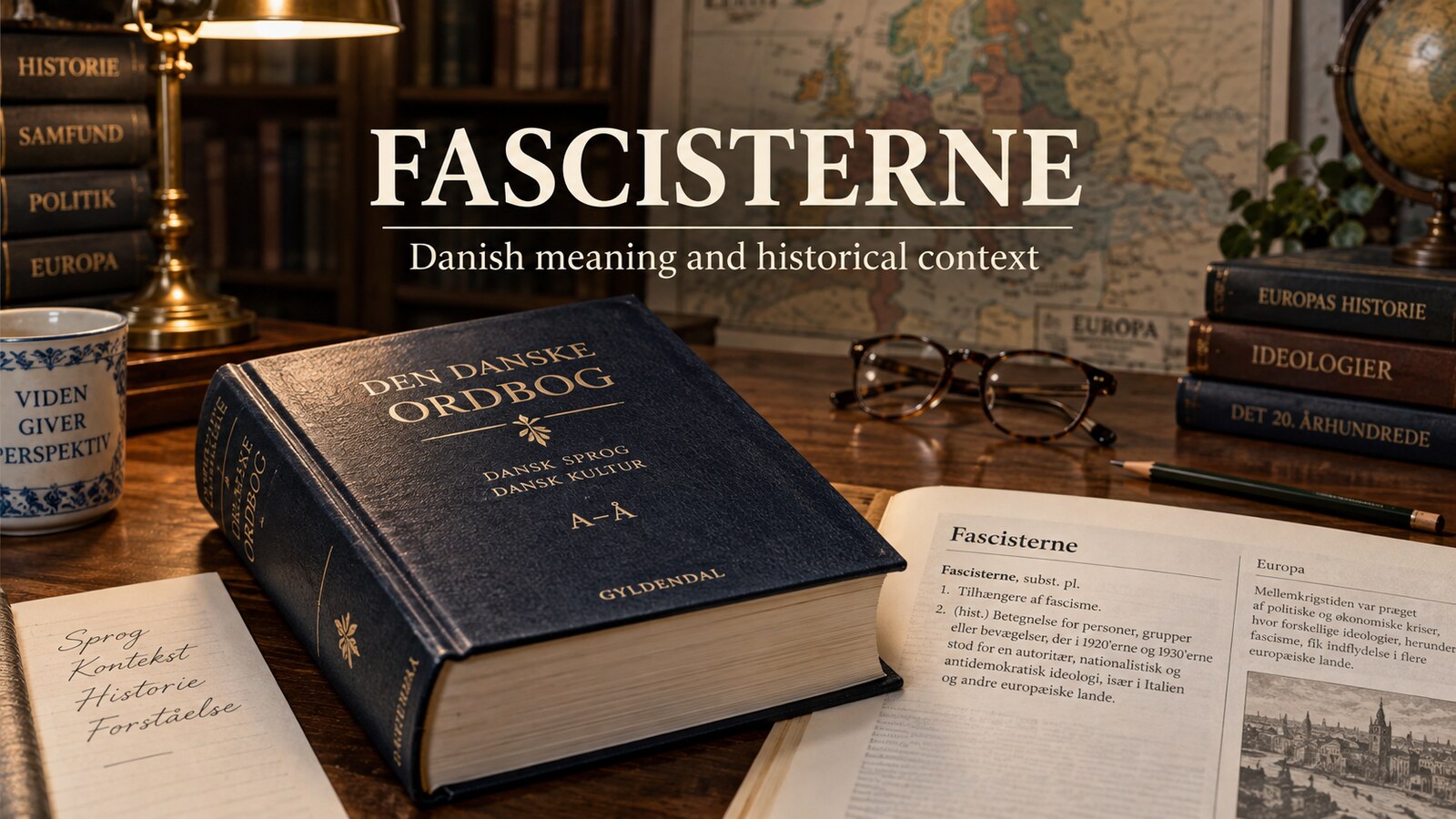
Fascisterne means “the fascists” in Danish. It is the definite plural of fascist, a noun referring to a supporter of fascism.
The ending is a grammatical marker, not the name of a separate ideology or organization. Understanding that distinction helps when reading Danish history, news or political discussion in translation.
How fascisterne is formed
Den Danske Ordbog’s entry for fascist gives the noun’s inflections as -en, -er and -erne. Those endings distinguish a particular individual, an unspecified plural and a definite plural.
| Danish form | English meaning | Grammatical role |
|---|---|---|
| en fascist | a fascist | Indefinite singular |
| fascisten | the fascist | Definite singular |
| fascister | fascists | Indefinite plural |
| fascisterne | the fascists | Definite plural |
English normally places “the” before this noun. Danish expresses that distinction through the ending in this form. A translation that drops “the” may lose the reference to a particular group already identified in the surrounding passage.
The people and the ideology are different words
Fascisterne names people. Fascisme names the ideology or political movement, as the separate Danish dictionary entry for fascisme shows. Keeping those categories apart prevents an awkward translation in which an abstract political system is mistaken for its supporters.
A sentence about what “the fascists” did still needs context to identify which people it means. The word alone supplies neither a country nor a date. It cannot establish that a passage concerns one particular party.
Why the historical context matters
The United States Holocaust Memorial Museum’s explanation of fascism describes an authoritarian, ultranationalist political philosophy that emerged in the early twentieth century. It places the nation above individual rights and rejects liberal democratic pluralism.
Its historical significance is tied especially to Italy and Germany between the world wars. A reader should not reduce the term to “a strict person” when a historical text is discussing movements that suppressed political opposition and accepted violence in pursuit of their aims.
Lex’s Danish encyclopedia article on fascism also notes difficulties in treating movements in different countries as identical. Shared characteristics do not erase differences in national circumstances, policies and development. A careful translation preserves those distinctions instead of importing details from another country.
Historical description or political accusation?
The dictionary records both the direct ideological meaning and a broader figurative use associated with strongly nationalist or authoritarian attitudes. That means the same noun can appear in a historical account or as an accusation in present-day debate. The grammatical translation remains straightforward, but the status of the claim changes.
When assessing a passage, ask who is using the label, whom it describes and what evidence accompanies it. An attributed accusation is not automatically an established classification. Translate the speaker’s words accurately without silently endorsing or softening them.
A practical way to read an unfamiliar passage
First identify the noun form. Next read the preceding sentence for the group being discussed. Then check whether the author is describing documented membership, explaining an ideology or quoting somebody’s criticism.
For example, an English translation may need “the fascists” because the Danish text has already introduced a specific movement. If the original passage does not name that movement, adding “Italian” or “German” would introduce information that the word itself does not contain. This is a translation principle, not an example quoted from an archival document.
Frequently asked questions
Is fascisterne singular or plural?
It is plural and definite. The closest English form is “the fascists.”
Is fascisterne a party name?
Not by itself. It is an ordinary noun form whose precise reference depends on context.
Does it mean fascism?
No. Fascism is fascisme; fascisterne refers to people.
Can it be used as an insult?
Yes, it can be used accusatorily or figuratively. That usage should be distinguished from a supported historical description.
Sources
Den Danske Ordbog, Lex and the United States Holocaust Memorial Museum provide the language and historical references linked above.
Related reading: supermaked: Meaning, Correct Spelling and How to Interpret It
