

A ServSafe practice test helps you prepare for food safety assessments by checking what you know about hygiene, contamination, temperature control, and safe kitchen procedures. You can start with the free sample questions below, review their explanations, and then identify the topics you need to study.
These are independently written study questions, not questions taken from an official ServSafe examination. Choose the Food Handler or Manager material that matches the credential your employer or local authority requires.
Free ServSafe Practice Test Questions and Answers
Try each question before looking at its answer. The scenarios emphasize decisions foodservice employees might face during an ordinary shift. Actual examinations can include different questions and wording.
Food Handler Practice Questions
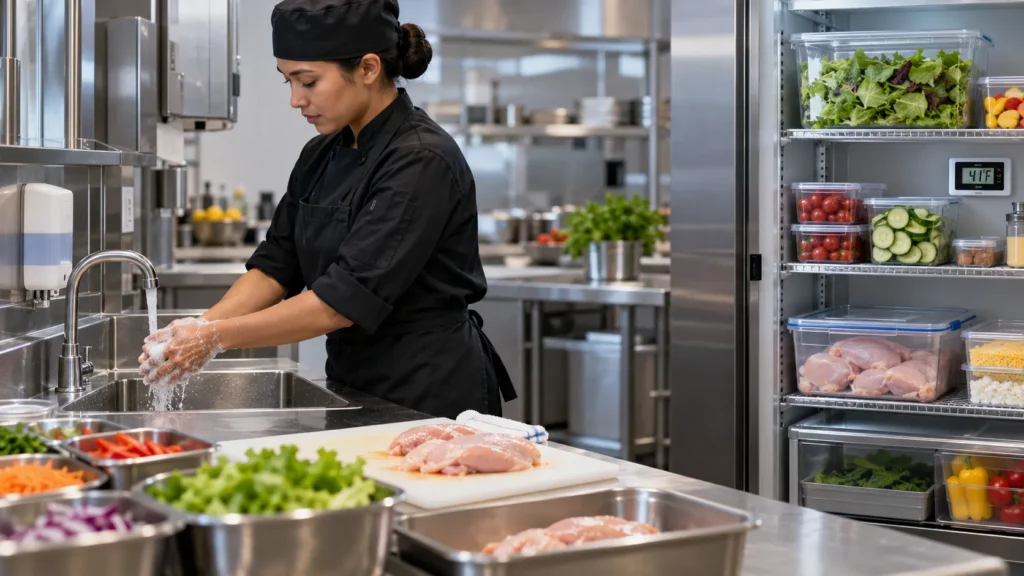
1. When should a food handler wash their hands?
A. Only at the beginning of a shift
B. After handling raw poultry and before touching ready-to-eat food
C. Only when gloves tear
D. After the shift ends
Answer: B. Raw poultry can carry harmful microorganisms. Washing hands before switching tasks helps prevent cross-contamination; gloves do not replace handwashing.
2. Where should raw chicken be stored in a shared refrigerator?
A. Above washed lettuce
B. Beside uncovered desserts
C. Below ready-to-eat foods, in a leakproof container
D. Anywhere if chilled
Answer: C. Store raw poultry so its juices cannot drip onto foods that will be eaten without further cooking.
3. A customer reports a severe food allergy. What should the employee do?
A. Remove the ingredient after cooking
B. Guess whether the dish is safe
C. Alert the manager and follow the establishment’s allergen procedures
D. Promise the dish contains no traces
Answer: C. Staff must verify ingredients and prevent allergen cross-contact. Never make assurances without confirming the preparation process.
4. Which temperature is appropriate for cold-holding most TCS foods under the FDA Food Code?
A. 50°F
B. 45°F
C. 41°F or lower
D. 60°F
Answer: C. Time/temperature control for safety (TCS) foods generally require cold holding at 41°F (5°C) or below, subject to specific exceptions.
5. An employee has vomiting symptoms before their shift. What is the appropriate first action?
A. Take medication and begin work
B. Tell the person in charge before handling food
C. Wear two pairs of gloves
D. Avoid only uncooked foods
Answer: B. Illness must be reported so the person in charge can apply the required exclusion or restriction rules.
ServSafe Manager Practice Questions
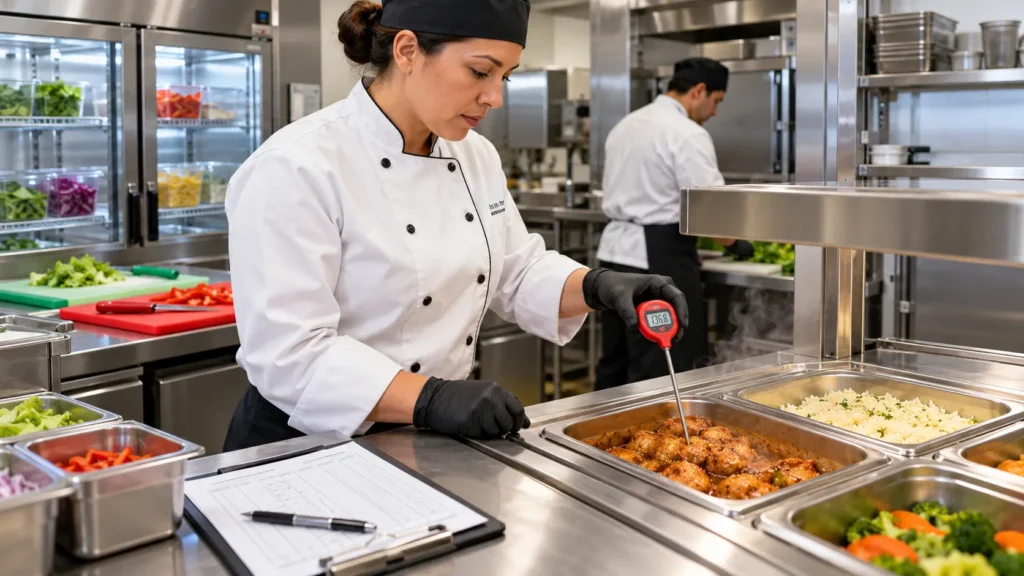
6. A hot-holding unit reads 125°F for a TCS food. What should the manager recognize?
A. It meets the usual hot-holding standard
B. The food is below the usual required temperature
C. It is safe if covered
D. Temperature does not matter after cooking
Answer: B. The usual FDA Food Code hot-holding minimum is 135°F (57°C). The corrective action depends on time, temperature history, and applicable procedures; reheating is not automatically sufficient.
7. A sanitized preparation table is touched by a dirty cloth. What should happen before reuse?
A. Wipe it with a dry towel
B. Leave it alone
C. Clean and sanitize the contaminated surface again
D. Sprinkle salt over it
Answer: C. Sanitizing cannot compensate for contamination that occurs afterward. The surface needs proper cleaning and sanitizing before food preparation resumes.
8. What is the strongest way to prevent allergen cross-contact during preparation?
A. Remove visible nuts from a finished dish
B. Use verified ingredients and cleaned, separate equipment or procedures
C. Cook everything longer
D. Tell customers allergies are rare
Answer: B. Small amounts of an allergen can matter. Ingredient checks and controlled preparation procedures are essential.
9. Why should a food thermometer be checked for accuracy?
A. To improve food appearance
B. To reduce paperwork
C. To ensure temperature readings are dependable
D. To replace handwashing
Answer: C. An inaccurate thermometer can cause staff to misjudge whether food has reached safe temperatures.
10. A manager notices repeated missed refrigeration checks. Which response best supports food safety?
A. Wait for an inspection
B. Rely on employee memory
C. Investigate the cause, retrain staff, and verify monitoring
D. Stop recording temperatures
Answer: C. Active managerial control involves identifying risks, correcting failures, and checking that controls work consistently.
ServSafe Manager vs. Food Handler: Which Test Do You Need?
ServSafe offers different learning routes. Food Handler training focuses on daily practices for employees who work with food. Manager certification examines broader responsibility for preventing foodborne illness and managing a food safety system.
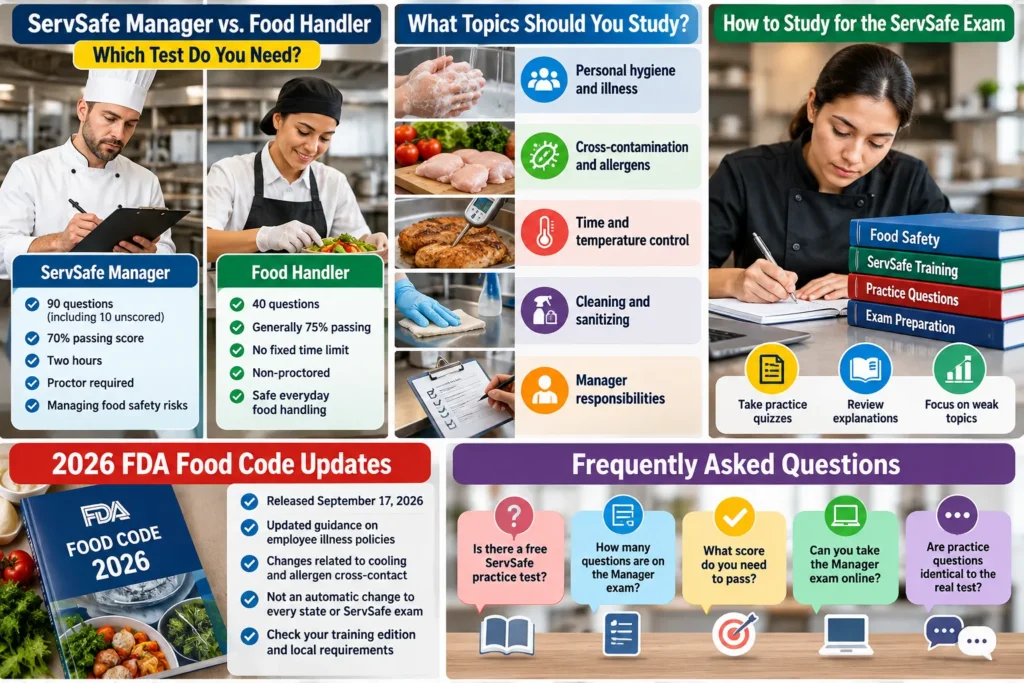
| Exam Detail | ServSafe Manager | Standard ServSafe Food Handler |
|---|---|---|
| Questions | 90, including 10 unscored pilot questions | 40 |
| Passing score | 70% of 80 scored questions | Generally 75% |
| Time | Two hours | No fixed time limit |
| Supervision | Approved proctor required | Standard online assessment is non-proctored |
| Main focus | Managing food safety risks | Safe everyday food handling |
According to ServSafe’s Manager FAQs, candidates must answer at least 56 of the 80 scored Manager questions correctly. Its Food Handler guidance states that the standard assessment permits three attempts; local requirements may differ. Passing a free practice quiz does not earn either credential.
What Topics Should You Study?
The most useful preparation covers more than isolated facts. Learn why procedures matter and what to do when something goes wrong.
Personal hygiene and illness: Review proper handwashing, glove use, employee illness reporting, and situations requiring a worker to be kept away from food handling.
Cross-contamination and allergens: Understand raw-food storage, separate equipment, ready-to-eat foods, ingredient verification, and the difference between contamination and allergen cross-contact.
Time and temperature control: Know appropriate cold and hot holding, safe cooking and cooling principles, thermometer use, and why elapsed time matters when temperatures fall outside limits.
Cleaning and sanitizing: Learn the difference between removing soil and reducing microorganisms, including how to follow sanitizer instructions and verify correct procedures.
Manager responsibilities: Study food safety management systems, corrective actions, staff training, monitoring records, and active managerial control.
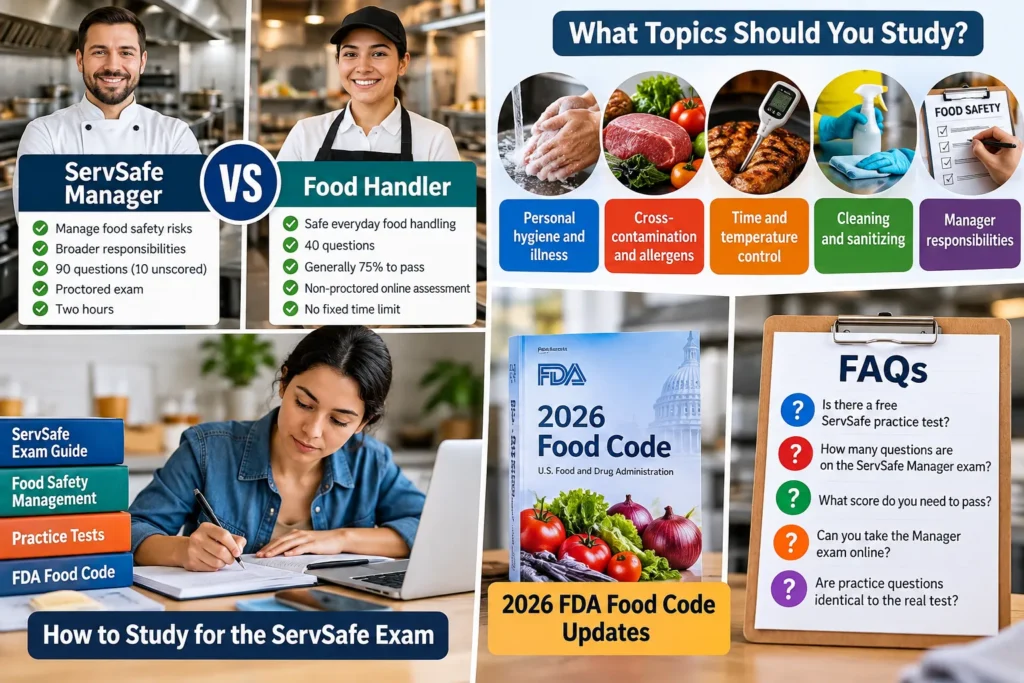
How to Study for the ServSafe Exam
Begin by confirming which credential your workplace or local health authority accepts. Then use the applicable official ServSafe training materials instead of relying solely on online answer lists. Reading explanations matters more than memorizing a sequence of letters.
Take a short practice quiz without notes. Review every incorrect answer and write down the underlying rule. If temperature questions are difficult, study that subject separately before trying another set. Repeat with different scenarios until you can explain your reasoning confidently.
For the Manager exam, practice making decisions under time pressure. Official online-proctor instructions allow two hours for the examination and describe identity and workspace requirements. Confirm your testing arrangements in advance; an ordinary video call with an unapproved remote supervisor is not an authorized substitute.
Does the 2026 FDA Food Code Change the Test?
The FDA released its 2026 Food Code on September 17, 2026. This model code addresses retail and restaurant food safety, including updated guidance involving employee illness policies, cooling, and allergen cross-contact.
However, a new Food Code is not automatically an immediate change to every state’s regulations or every ServSafe exam question. Check the training edition assigned to your course and your local authority’s requirements. The FDA Food Code page provides official updates; ServSafe remains the appropriate source for specific examination rules.
FAQs
Is there a free ServSafe practice test?
Yes. Independent websites offer free sample questions, including those provided above. Some also sell expanded question banks. Free practice is useful for study but does not grant certification.
How many questions are on the ServSafe Manager exam?
There are 90 multiple-choice questions. Ten are unscored pilot questions, leaving 80 that determine the result.
What score do you need to pass?
The Manager requirement is 70%, or 56 of 80 scored questions. The standard Food Handler assessment generally requires 75%, although some jurisdictions set different requirements.
Can you take the Manager exam online?
Yes, through an approved proctored arrangement. Check ServSafe’s current options and your jurisdiction’s acceptance rules before registering.
Are practice questions identical to the real test?
Not necessarily. Independent quizzes should help you learn food safety principles, not promise confidential exam questions or guaranteed passing results.
Also, Read: HRMS Globex
