

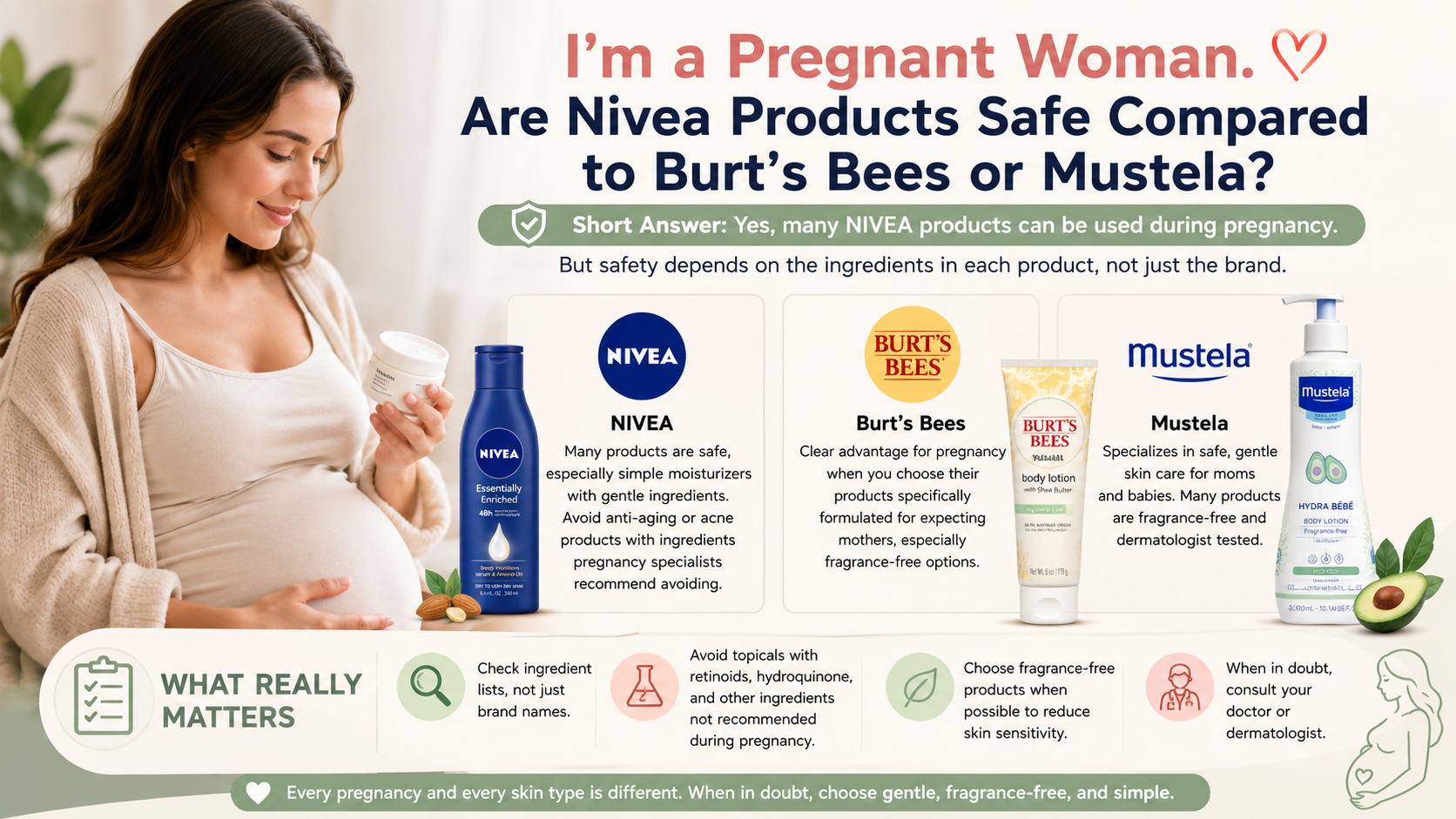
Yes, many NIVEA products can be used during pregnancy, but NIVEA is a very large skincare range, so the brand name alone does not tell you whether a specific product is appropriate. For pregnancy, Burt’s Bees and Mustela have a clearer advantage when you choose their products specifically designed for expecting mothers, particularly fragrance-free formulas.
The most important point is to compare individual ingredient lists rather than brands. A simple moisturizer containing glycerin, shea butter, oils, or other basic emollients is a very different situation from an anti-aging or acne product containing ingredients that pregnancy specialists recommend avoiding. The American Academy of Dermatology advises pregnant people to avoid topical retinoids and hydroquinone, while ACOG recommends checking cosmetic ingredients and choosing fragrance-free products when possible.
Are NIVEA products safe during pregnancy?
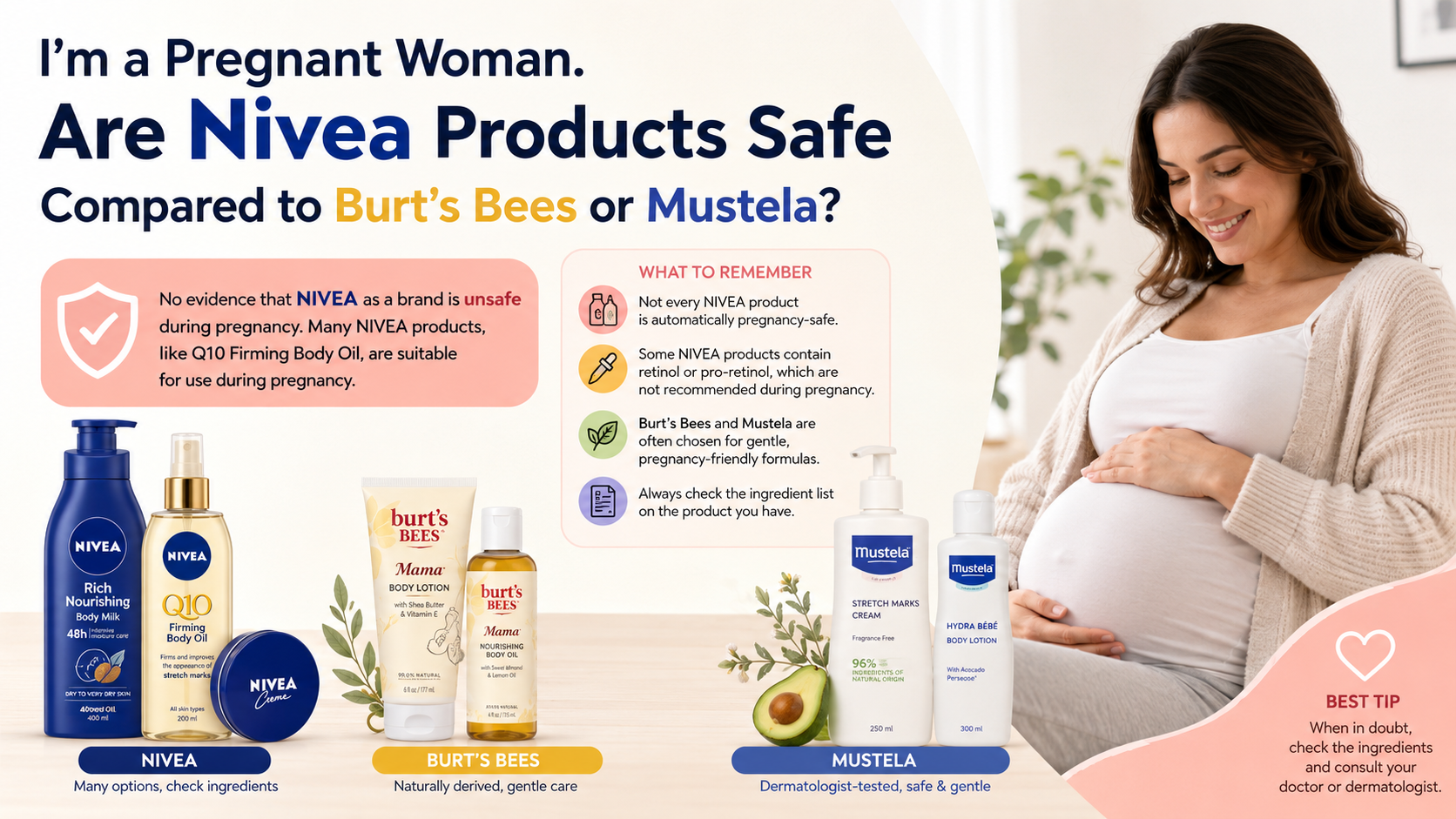
There is no evidence that NIVEA as a brand should be considered unsafe during pregnancy. In fact, NIVEA itself states that its Q10 Firming Body Oil is suitable for use during pregnancy, including massage of the belly and areas affected by stretch marks.
That does not mean every NIVEA product is automatically pregnancy-safe. NIVEA sells hundreds of products across body care, facial skincare, anti-aging treatments, exfoliants, sun care, and other categories. The company also sells products containing retinol and pro-retinol, ingredients that dermatologists advise avoiding during pregnancy.
This distinction is especially important because skincare formulas change. NIVEA notes on its product pages that ingredient declarations can be updated as formulas are modified, and the ingredient list printed on the package is the one that should be checked for the product you actually have.
So, asking whether “NIVEA” is safe is less useful than asking, “Is this specific NIVEA formula appropriate during pregnancy?”
How does NIVEA compare with Burt’s Bees and Mustela?
For a basic pregnancy body moisturizer, all three brands can offer reasonable choices. The difference is that Burt’s Bees and Mustela have dedicated maternity products, making the selection process easier.
| Brand | Pregnancy-focused options | Fragrance-free option | Main consideration |
|---|---|---|---|
| NIVEA | Yes, including Q10 body products | Depends on the product | Large range means you need to check the individual formula |
| Burt’s Bees | Yes, Mama products | Yes, Mama Belly Butter | Pregnancy-specific formulas are easy to identify |
| Mustela | Extensive maternity range | Yes, Stretch Marks Cream Fragrance-Free | Strong focus on pregnancy and sensitive skin |
The table is a practical comparison, not a claim that one company’s entire range is safer than another’s.
Burt’s Bees’ Mama Belly Butter is specifically marketed for pregnancy and is currently listed as fragrance-free. Its published ingredient list includes sunflower oil, glycerin, coconut oil, sweet almond oil, shea butter, jojoba butter, cocoa butter, vitamin E, and other ingredients. Burt’s Bees also states that the product is formulated without phthalates, parabens, petrolatum, and SLS.
Mustela’s current Stretch Marks Cream Fragrance-Free is also specifically formulated for pregnancy. The company states that it is fragrance-free, tested under dermatological and gynecological control, and intended for use from the first month of pregnancy through postpartum. Its published formula includes ingredients such as glycerin, shea butter, avocado oil, avocado-derived ingredients, vitamin E, and plant extracts.
NIVEA therefore should not be treated as an inferior option simply because it is not exclusively a maternity brand. The real issue is which NIVEA product you are using.
Burt’s Bees vs. Mustela during pregnancy
Between Burt’s Bees and Mustela, the choice often comes down to what you value most.
Burt’s Bees Mama Belly Butter has a relatively straightforward, moisturizing formula and is explicitly fragrance-free. Its combination of plant oils and butters makes it particularly suitable for someone who mainly wants to reduce dryness, tightness, and discomfort as the abdomen expands.
Mustela has a more specialized pregnancy skincare approach. Its fragrance-free stretch-mark cream contains avocado oil, avocado peptides, maracuja extract, glycerin, shea butter, and other conditioning ingredients. The company states that the formula contains 97% ingredients of natural origin under the ISO 16128 definition and is designed specifically for pregnancy and postpartum use.
That makes Mustela especially appealing to someone who wants a dedicated maternity product with an emphasis on fragrance-free care.
Burt’s Bees has an equally important pregnancy-specific option, but its broader “natural” positioning should not be interpreted as proof that every Burt’s Bees skincare product is automatically safer. In fact, the brand’s pregnancy body oil contains sweet almond oil, lemon oil, vitamin E, rosemary extract, and fragrance-related components in some current regional ingredient listings.
For someone who becomes more sensitive to smells during pregnancy, that makes the fragrance-free Burt’s Bees Belly Butter a more logical choice than automatically choosing every Burt’s Bees product labeled natural.
Is NIVEA better or worse than Burt’s Bees and Mustela?
There is no evidence-based reason to say that one brand is universally safer.
A better way to think about the comparison is:
For ordinary body moisturization: NIVEA can be perfectly reasonable when the formula contains uncomplicated moisturizing ingredients and does not contain an ingredient your clinician has advised you to avoid.
For pregnancy-specific body care: Burt’s Bees and Mustela make the shopping process easier because they offer products explicitly designed for pregnancy.
For fragrance sensitivity: Mustela’s fragrance-free maternity cream and Burt’s Bees fragrance-free Mama Belly Butter have an advantage over strongly scented products. ACOG specifically suggests looking for products labeled “fragrance free,” noting that “unscented” does not necessarily mean the same thing.
For facial anti-aging products: ingredient checking becomes much more important because some NIVEA products contain or discuss retinol and pro-retinol. These should not be treated the same way as a simple body lotion.
Which NIVEA ingredients deserve attention during pregnancy?
The biggest mistake is assuming that every ingredient with a scientific-sounding name is dangerous. Many cosmetic ingredients are simply moisturizers, stabilizers, preservatives, emulsifiers, or texture agents.
Instead, focus on ingredients with established pregnancy concerns.
Retinoids and retinol
This is the clearest category to watch.
The American Academy of Dermatology recommends avoiding topical retinoids during pregnancy. Its pregnancy skincare guidance specifically lists prescription retinoids such as tretinoin and tazarotene as well as over-the-counter products containing retinol among ingredients to avoid.
NIVEA itself explains that retinol is a vitamin A derivative and states that it should not be used during pregnancy because it could be harmful to the developing fetus.
So, do not assume an NIVEA anti-aging product is safe simply because it is sold over the counter. Read the label.
Hydroquinone
Hydroquinone is another ingredient the American Academy of Dermatology recommends avoiding during pregnancy.
If a skincare product is marketed as an intensive skin-lightening treatment, checking the complete ingredient list becomes particularly important.
Salicylic acid
This one requires more nuance.
ACOG lists topical salicylic acid among certain over-the-counter ingredients that can be used during pregnancy, while the AAD recommends discussing or limiting high-dose salicylic acid above 2% during pregnancy.
That means the presence of “salicylic acid” on a label does not automatically mean the product is dangerous. Concentration, product type, frequency, and the reason you are using it all matter.
Fragrance and essential oils
Fragrance is not the same thing as a proven fetal toxin. The bigger practical issue is that pregnancy can make skin more sensitive, and fragrance ingredients can be irritating or unpleasant for people experiencing nausea or increased sensitivity to smells.
The AAD recommends considering fragrance-free products to reduce irritation, while ACOG recommends choosing fragrance-free beauty and personal care products when possible. AAD also advises pregnant patients to discuss or limit certain essential oils because evidence about their pregnancy safety is limited.
This is one reason the fragrance-free options from Mustela and Burt’s Bees can be attractive choices even when a fragranced lotion is not otherwise considered hazardous.
What about NIVEA Q10 products?
Q10 itself should not be confused with retinol.
NIVEA’s current Q10 body products use ubiquinone, or coenzyme Q10, as a skin-care ingredient. For example, the current Q10 Firming Body Lotion + Vitamin C lists ubiquinone along with glycerin, shea butter, dimethicone, vitamin C derivative, preservatives, fragrance allergens, and other cosmetic ingredients.
NIVEA also specifically identifies its Q10 Firming Body Oil as suitable for pregnancy massage.
That makes a Q10 body product a very different category from a NIVEA facial treatment containing retinol or pro-retinol.
Still, fragrance and individual skin tolerance remain relevant. A current NIVEA Q10 body lotion contains parfum and several fragrance components, including linalool, citronellol, benzyl alcohol, and limonene.
Someone with very reactive or eczema-prone skin may therefore prefer a simpler, fragrance-free product even though the ingredients are not automatically unsafe for pregnancy.
Is “natural” automatically safer during pregnancy?
No.
This is an important distinction when comparing Burt’s Bees with NIVEA or Mustela.
Burt’s Bees emphasizes natural-origin formulas, and its Mama Belly Butter is currently described as 100% natural origin on the U.S. product page.
Mustela’s fragrance-free maternity cream is listed as 97% ingredients of natural origin according to the ISO 16128 definition.
Those statements describe how ingredients are classified, but they do not establish that a product is safer simply because its ingredients come from natural sources.
The AAD specifically notes that some essential oils have limited pregnancy safety information and recommends discussing them with a dermatologist.
So the better rule is evidence first, marketing label second.
Can pregnancy lotions actually prevent stretch marks?
This is where marketing claims need to be viewed carefully.
ACOG states that there is no proof that treatments marketed to prevent stretch marks actually prevent them. A heavy moisturizer may keep skin soft, but that does not mean it will eliminate or reliably prevent stretch marks.
A Cochrane review of topical preparations for preventing stretch marks during pregnancy likewise found no high-quality evidence supporting any topical preparation as a reliable prevention method.
This matters when comparing NIVEA, Burt’s Bees, and Mustela. You can reasonably choose one because it helps moisturize, soften, and improve comfort, but it would be misleading to promise that any of these creams can guarantee stretch-mark prevention.
In other words, paying more for a maternity product does not automatically mean you are buying a scientifically proven stretch-mark prevention treatment.
Which is best for sensitive pregnancy skin?
For a pregnant woman whose main concern is dry, tight, itchy, or easily irritated skin, the simplest formula is usually the better starting point.
The AAD recommends gentle skin care during pregnancy, including regular moisturizing, and specifically suggests fragrance-free products to reduce irritation.
A sensible ranking for this particular use would be:
| Situation | Practical choice |
|---|---|
| Want a dedicated pregnancy moisturizer | Mustela Stretch Marks Cream Fragrance-Free |
| Want a fragrance-free belly butter | Burt’s Bees Mama Belly Butter |
| Prefer NIVEA and want a pregnancy-focused body product | NIVEA Q10 Firming Body Oil |
| Want a general NIVEA lotion | Check the full ingredient list first |
| Want an anti-aging face product | Check carefully for retinol/pro-retinol |
| Have unusually sensitive skin | Prefer fragrance-free, uncomplicated moisturizers |
This ranking is about formula suitability and convenience, not a medical determination that one company is categorically safer than the others.
What should you look for on the label?
When shopping for skincare during pregnancy, look past the front of the package.
A useful checklist is:
- Read the full ingredient list, especially for facial treatments and concentrated products.
- Avoid products containing retinoids or retinol unless your pregnancy-care clinician specifically tells you otherwise.
- Avoid hydroquinone during pregnancy.
- Consider fragrance-free products if your skin is sensitive or you are bothered by smells.
- Do not assume “natural,” “organic,” or “plant-based” automatically means pregnancy-safe.
- If you are treating acne, pay attention to the concentration and type of ingredients such as salicylic acid rather than assuming all use is prohibited.
- Check the current package label, because formulations can change. NIVEA explicitly notes this on its product information pages.
What if I have already used NIVEA while pregnant?
Do not panic solely because you used a regular NIVEA moisturizer before checking the ingredients.
Many ordinary moisturizers contain basic emollients and humectants, and not every cosmetic ingredient presents a pregnancy concern. The important step is to identify the exact product and ingredient list, particularly if it is a facial anti-aging treatment, acne product, skin-lightening treatment, or another highly active formula.
For example, an ordinary body lotion is not automatically comparable to a product containing retinol. The AAD recommends discussing skincare medications and potentially concerning ingredients with your obstetrician or dermatologist during pregnancy.
If you discover that a product contains an ingredient you have been advised to avoid, stop using it and ask your healthcare professional whether any further action is needed.
What about breastfeeding after the baby arrives?
Pregnancy and breastfeeding are not exactly the same situation, so skincare guidance can change after delivery.
Mustela currently states that its fragrance-free Stretch Marks Cream is compatible with breastfeeding when proper skin-care hygiene is followed. It also advises not to apply the product directly to recent C-section scars.
Burt’s Bees similarly instructs users of its Mama Belly Butter to wipe the product off the breasts before nursing.
That is a good reminder that a product can be suitable for use on the body while still requiring extra care around the nipple and breast area.
What is the safest simple routine during pregnancy?
For many pregnant women, skincare does not need to become complicated.
A simple routine can be built around gentle cleansing, moisturizing, and sun protection. The AAD recommends cleansing up to twice daily, moisturizing according to your skin type, and using broad-spectrum SPF 30 or higher on exposed skin. It also recommends considering mineral sunscreen ingredients such as zinc oxide or titanium dioxide during pregnancy, particularly for people concerned about irritation.
For the body, a straightforward moisturizer can be used whenever the skin feels dry or tight. A maternity product such as Mustela’s fragrance-free cream or Burt’s Bees Mama Belly Butter can make sense if you prefer a pregnancy-specific formula. A NIVEA body product can also be reasonable when its ingredient list matches your needs.
The goal does not need to be the most expensive or most “natural” routine. Gentle, well-tolerated, uncomplicated skincare is often the most practical approach.
So, is NIVEA safe compared with Burt’s Bees or Mustela?
For pregnancy body care, NIVEA, Burt’s Bees, and Mustela can all have suitable products, but they should not be judged as entire brands.
If you want the easiest pregnancy-specific choice, Mustela’s fragrance-free maternity cream is particularly straightforward because it is specifically formulated and labeled for pregnancy. Burt’s Bees Mama Belly Butter is another strong option when you want a fragrance-free, pregnancy-focused moisturizer.
NIVEA is also a reasonable choice when you select the right formula. The company’s own current guidance specifically identifies its Q10 Firming Body Oil as suitable for use during pregnancy.
The bigger caution is with NIVEA’s extensive facial and anti-aging range. Some products contain or use retinol-related ingredients, and those should not be treated like ordinary body moisturizers during pregnancy.
So the most evidence-based answer is this: Mustela and Burt’s Bees may be easier choices for pregnancy-focused skincare, but NIVEA is not inherently unsafe. The exact formula, ingredient list, concentration, and intended use matter far more than the logo on the bottle.
Also Read: I’m a Skincare Beginner. Is Nivea a Good Starting Brand Compared to Garnier?
FAQ
Can I use NIVEA lotion while pregnant?
Many NIVEA body lotions can be used during pregnancy, but you should check the specific formula first. NIVEA’s current guidance identifies its Q10 Firming Body Oil as suitable for pregnancy, while the brand also sells facial products containing retinol or pro-retinol that should be avoided during pregnancy.
Is Mustela safer than NIVEA for pregnancy?
Not necessarily as an entire brand. Mustela has a strong advantage in pregnancy-specific product design, including a fragrance-free stretch-mark cream labeled for pregnancy. That makes product selection easier, but it does not prove that all Mustela products are safer than all NIVEA products.
Is Burt’s Bees safe during pregnancy?
Its pregnancy-specific products, such as Mama Belly Butter, are specifically designed for expecting mothers. The current Mama Belly Butter is fragrance-free and lists plant oils, butters, glycerin, and vitamin E among its ingredients.
Should I choose fragrance-free skincare while pregnant?
Fragrance-free products are a sensible choice, particularly if your skin is sensitive. ACOG recommends looking for products marked fragrance free, and the AAD also recommends fragrance-free skincare to help reduce irritation.
Can NIVEA Q10 be used during pregnancy?
NIVEA specifically states that its Q10 Firming Body Oil can be used during pregnancy for belly massage and stretch-mark areas. That guidance applies to the named product, not automatically to every Q10 or NIVEA product.
Can pregnancy creams prevent stretch marks?
There is not strong evidence that any cream, lotion, or oil can reliably prevent stretch marks during pregnancy. Moisturizers can still improve softness and comfort, which can make them useful as part of a normal skincare routine.
What should I do if I am unsure about one specific product?
Check the current ingredient list on the package and discuss the product with your obstetrician, midwife, dermatologist, or pharmacist, especially if it is a treatment product rather than a basic moisturizer. Pregnancy skincare decisions are most reliable when they are based on the exact formula rather than the brand name.

1 Comment
Pingback: I’m a 30-Year-Old Working Mom. How Do Olay Moisturizers Perform Compared to L’Oréal’s Skincare Line?