

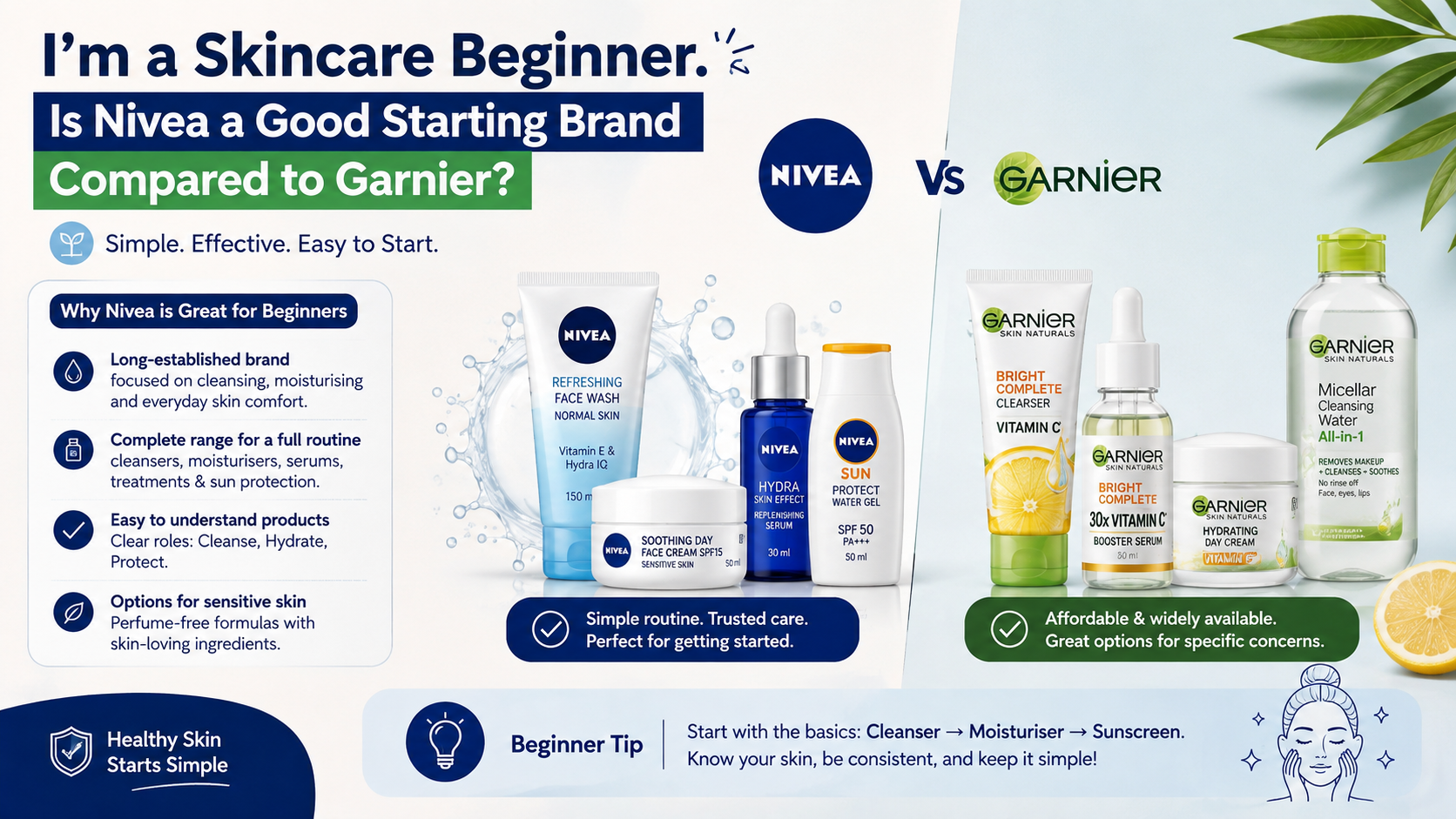
For a skincare beginner, both Nivea and Garnier can be reasonable starting brands, but they are not equally strong for every skin type or goal. Nivea generally makes it easier to build a simple moisturizing routine, while Garnier offers a broader selection of products built around specific concerns such as blemishes, dark spots, hydration, and brightening.
The better choice is therefore not simply the brand with the best reputation. It is the brand that gives you simple, suitable products for your skin type without making your routine unnecessarily complicated. Dermatologists generally recommend starting with a gentle cleanser, moisturizer, and broad-spectrum sunscreen rather than jumping into a long list of active ingredients.
Nivea vs. Garnier for Beginners at a Glance
| Category | Nivea | Garnier |
|---|---|---|
| Beginner-friendly basics | Excellent | Very good |
| Moisturizers | Strong selection | Strong selection |
| Gentle cleansing | Strong | Strong, especially micellar water |
| Sensitive-skin options | Strong selection | Strong selection |
| Acne and blemish-focused products | Good and expanding | Very strong |
| Brightening products | Good | Very strong |
| Active ingredients | Moderate to extensive | Extensive |
| Simple routine building | Very easy | Easy, but more choices can be confusing |
| Product variety | Broad | Very broad |
| Best for a first-time minimalist | Nivea | Good |
| Best for specific skin concerns | Good | Garnier |
This comparison is based on the brands’ current UK skincare ranges and official product information. Product availability and formulations can vary by country, so beginners should always check the ingredient list on the package before purchasing.
Why Nivea Can Be a Good Starting Brand
Nivea has a long-established focus on cleansing, moisturising, skin comfort, and everyday care, which makes it relatively straightforward for someone who has never had a skincare routine before.
Its current face-care range includes cleansers, moisturisers, day creams, night creams, serums, treatments, and sun-protection products. That gives a beginner enough choice to create a complete routine without necessarily having to combine several specialist brands.
One of Nivea’s biggest advantages for beginners is that many of its products are easy to understand. A basic cleanser is intended to clean the skin, a moisturizer is intended to hydrate it, and sunscreen is intended to provide UV protection. That sounds obvious, but keeping those roles clear can prevent beginners from buying five different treatment products before they even know what their skin needs.
Nivea also has dedicated sensitive-skin options. For example, its Soothing Day Face Cream SPF15 is described as perfume-free and designed for sensitive skin, with ingredients including glycerin, panthenol and shea butter.
The brand also provides a current sensitive-skin routine based around gentle cleansing, moisturising, and sun protection. Its own guidance recommends a minimalist approach when dealing with sensitivity and suggests patch testing new products before applying them broadly.
That basic philosophy lines up well with dermatology guidance. The American Academy of Dermatology recommends a simple routine built around a gentle cleanser, fragrance-free moisturizer, and broad-spectrum sunscreen with SPF 30 or higher.
Where Garnier Has an Advantage
Garnier becomes particularly interesting when a beginner has a specific skin concern rather than simply wanting basic skincare.
Its current skincare range includes micellar waters, cleansers, moisturisers, serums, sheet masks, daily UV products, BB creams, spot patches, and treatment products. It also has dedicated ranges such as Vitamin C, Hyaluron, Micellar, and Pure Active.
That means Garnier can be useful for someone who says, “I want a routine, but I also have oily skin, blackheads, blemishes, or dull-looking skin.”
For example, Garnier’s Pure Active range currently includes products based around ingredients such as salicylic acid, niacinamide, AHA, and BHA. Its Pure Active Salicylic Purifying Gentle Cleanser combines salicylic acid, niacinamide, clay and ceramides and is marketed as fragrance-free and suitable for sensitive skin.
Garnier also has products targeting blemishes and congested skin. Its Pure Active range includes a salicylic acid cleanser, treatment serum, blemish patches and an SPF 50+ daily UV fluid as part of a more targeted routine.
This makes Garnier attractive once a beginner understands what they are trying to address.
The problem is that more choice can also create more confusion. A first-time skincare user may see vitamin C, hyaluronic acid, salicylic acid, niacinamide, charcoal, exfoliating acids and multiple serums and assume that using all of them together will produce faster results. That is not a good beginner strategy.
Dermatologists emphasize that adding more products is not automatically better. The AAD specifically recommends starting simple and introducing additional products according to individual needs.
Which Brand Is Easier for a Complete Beginner?
For someone who has never used skincare before, Nivea has a slight advantage for simplicity.
That does not mean Nivea products are universally better. It means that a beginner can more easily start with a small number of familiar product categories and learn how their skin responds.
A basic Nivea routine could look something like this:
Morning: gentle cleanser or water rinse, moisturizer if needed, and SPF 30+ sunscreen.
Evening: gentle cleanser followed by moisturizer.
That is enough to establish the fundamentals.
Garnier can produce the same type of simple routine, particularly with its sensitive-skin micellar products and hydrating products. Its Micellar Cleansing Water for sensitive skin is designed to cleanse and remove makeup while hydrating, and Garnier states that the product has been tested by dermatologists and ophthalmologists.
So Garnier is not a bad beginner brand at all. Its main challenge is that the wider range of targeted products can tempt beginners to do too much too soon.
Nivea vs. Garnier for Sensitive Skin
Sensitive skin changes the comparison considerably.
The most important factor is the individual formula, not simply whether the bottle says Nivea or Garnier.
Nivea has dedicated sensitive-skin products, including fragrance-free options. Its sensitive-skin guidance also advises a minimalist routine and patch testing before using a new facial product more widely.
Garnier also has products designed specifically for sensitive skin. Its sensitive-skin micellar water is promoted as gentle and suitable for sensitive skin, while its current Pure Active Salicylic Purifying Gentle Cleanser is described as fragrance-free and suitable for sensitive skin.
However, not every Garnier or Nivea product is suitable for sensitive skin. Product ranges contain different formulations, and some include fragrance or other ingredients that particular users may not tolerate.
The American Academy of Dermatology recommends fragrance-free products for people with sensitive or easily irritated skin because fragrance can contribute to irritation or allergic reactions.
This is why choosing a “sensitive” product within either brand is often more meaningful than choosing one brand as a whole.
Which Is Better for Dry Skin?
For beginners with dry skin, Nivea can be particularly appealing because of its strong moisturizer-focused lineup.
Moisturizers are important because they help maintain hydration and support the skin’s protective barrier. Dermatologists commonly recommend applying moisturizer after cleansing, with ingredients such as ceramides and hyaluronic acid being useful options depending on the formula and individual’s needs.
Nivea’s face-care range contains numerous moisturizers aimed at different needs, including dry and sensitive skin.
Garnier also has several good hydration-oriented products. Its current Hyaluron range, for example, includes products built around glycerin, panthenol, aloe vera and hyaluronic acid.
The important warning is that hydrating ingredients do not automatically make every formula appropriate for every dry-skin beginner. One Garnier Hyaluronic Aloe nourishing cream, for example, currently lists denatured alcohol and fragrance among its ingredients, demonstrating why reading the actual ingredient list matters even when a product is marketed around hydration.
Which Is Better for Oily or Blemish-Prone Skin?
This is where Garnier has a clearer advantage.
Its Pure Active collection is specifically built around blemish-prone and congested skin and includes products containing ingredients such as salicylic acid and niacinamide. Garnier’s current Pure Active range also contains dedicated products for blemishes, blackheads, uneven texture and excess oil.
Salicylic acid is a beta-hydroxy acid commonly used in products targeting clogged pores and blemishes. Garnier’s own product information identifies salicylic acid as an active ingredient that helps exfoliate skin and address concerns such as blackheads and pores.
Nivea also offers products for blemish-prone skin. Its current face-cleansing range includes the Derma Skin Clear line with products focused on acne and blemish care.
Still, if the main reason you are starting skincare is oiliness, blackheads or occasional blemishes, Garnier’s current range gives a beginner more purpose-built options.
There is one important catch. Active ingredients can be useful, but a beginner should not assume that a stronger or more complicated routine is automatically better. The AAD notes that ingredients such as salicylic, glycolic and lactic acids can help with oily skin but may be too harsh for some people, particularly when irritation develops.
What About Brightening and Dark Spots?
Garnier has the stronger reputation and broader current selection for brightening-focused skincare.
Its Vitamin C range includes micellar water, liquid care, serum and daily UV products positioned around brighter-looking and more even-looking skin.
Its Vitamin C Micellar Cleansing Water, for example, combines micellar cleansing technology with a vitamin C derivative and is marketed for cleansing while helping brighten the appearance of the complexion.
Nivea also offers products aimed at pigmentation and uneven tone. Its current face-care range includes the LUMINOUS630 line for age spots and dark spots, as well as products containing ingredients such as vitamin C and niacinamide.
For a beginner, though, brightening should usually come after the basics are established. Daily sun protection is particularly important because UV exposure contributes to premature skin aging and pigmentation. The AAD recommends broad-spectrum SPF 30 or higher as part of a daily skin-care routine.
Does a More Expensive Brand Mean Better Skincare?
Not necessarily.
Nivea and Garnier are both widely accessible mainstream skincare brands, and neither needs to be treated as a luxury alternative for a beginner to establish an effective routine.
The key issue is formulation and suitability, not the perceived status of the brand.
A relatively inexpensive moisturizer that your skin tolerates well may be more useful than an expensive product containing unnecessary ingredients that irritate you. The AAD similarly advises consumers to choose products that fit their skin type and budget rather than assuming that higher cost automatically means better results.
This is particularly important for beginners because consistency matters. A basic routine you can comfortably maintain is more practical than a complicated routine you abandon after a few weeks.
What Should a Skincare Beginner Actually Buy?
The best starting routine is much smaller than many social media routines suggest.
1. A Gentle Cleanser
Choose a cleanser that removes dirt, oil and sunscreen without leaving your face uncomfortably tight or irritated.
The AAD recommends a gentle cleanser and advises limiting cleansing to twice daily, or less frequently for some people with dry or sensitive skin.
Both Nivea and Garnier have suitable options, so this category does not require choosing one brand over the other.
2. A Moisturizer
A moisturizer should match your skin type and feel comfortable enough to use consistently.
For dry or sensitive skin, beginners may want to prioritize a fragrance-free formula and look for ingredients associated with barrier support and hydration.
Nivea has a particularly broad selection of straightforward moisturizers, but Garnier also offers many hydrating products.
3. Sunscreen
This is the step beginners should not overlook.
The AAD recommends sunscreen that provides broad-spectrum protection, SPF 30 or higher, and water resistance, with reapplication when appropriate during outdoor exposure.
Some Nivea and Garnier face products include SPF, but an SPF-containing moisturizer should not automatically be treated as interchangeable with every dedicated sunscreen. Check the product’s stated protection level and usage instructions.
4. One Treatment, Only When You Need It
After your basic routine is working, you can consider a treatment for a specific issue.
For example:
| Skin concern | Ingredient often used for the concern | Beginner approach |
|---|---|---|
| Dryness | Glycerin, hyaluronic acid, ceramides | Start with moisturizer |
| Blemishes | Salicylic acid | Introduce gradually |
| Uneven tone | Niacinamide or vitamin C | Add one product at a time |
| Sun-related pigmentation | Sunscreen | Make daily SPF the priority |
| Sensitive skin | Simple, fragrance-free formulas | Minimize active ingredients initially |
The important principle is one new product at a time. If you introduce three new products simultaneously and develop irritation, it becomes much harder to identify the cause.
Is Nivea More Beginner-Friendly Than Garnier?
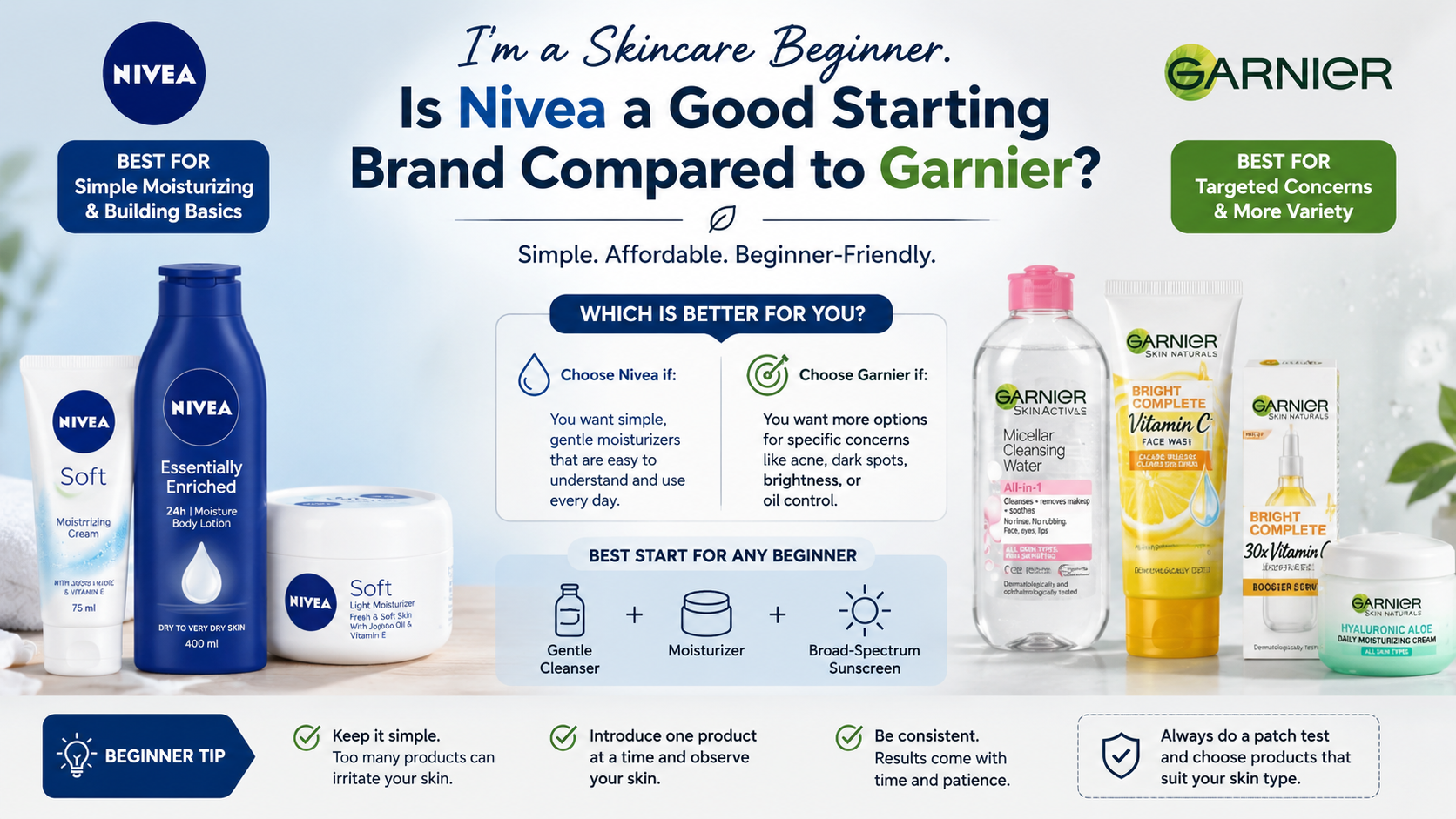
In general, yes, slightly, especially for someone whose goal is simply to learn the basics.
Nivea’s traditional strength in everyday moisturization and straightforward face-care products makes it easy to understand the basic routine. Its current range also includes dedicated sensitive-skin choices and several facial cleansers and moisturizers.
Garnier is also beginner-friendly, but it becomes more useful when the beginner has a particular objective. Its current product lineup covers hydration, vitamin C, blemish treatment, micellar cleansing and targeted active ingredients.
So the distinction is less about good brand versus bad brand and more about simple foundation versus targeted treatment.
When Garnier May Be the Better First Choice
Choose Garnier first when your main reason for starting skincare is a clearly defined concern such as:
- Blackheads or blemishes
- Excess oil
- Dull-looking skin
- Uneven-looking skin tone
- A desire for micellar cleansing
- An interest in targeted active ingredients
Its current Pure Active and Vitamin C ranges make these areas particularly easy to explore.
Even then, beginning with one or two basic products is usually smarter than buying an entire treatment range immediately.
When Nivea May Be the Better First Choice
Nivea may be the better starting point when you mainly want:
- A simple skincare routine
- Basic hydration
- Dry or normal skin care
- Straightforward moisturizer options
- Sensitive-skin choices
- A gradual introduction to facial skincare
Its current face-care lineup includes multiple moisturizer, cleanser, sensitive-skin and sun-care options, making it practical for building a routine without immediately focusing on strong active treatments.
Common Beginner Mistakes With Both Brands
Buying from a reputable brand does not automatically prevent skincare mistakes.
One of the most common problems is using too many active products at once. Beginners sometimes combine exfoliating acids, vitamin C, retinoids, scrubs and spot treatments because each product promises a specific benefit. In reality, this can make irritation much more likely.
Another mistake is choosing based entirely on marketing terms such as “natural,” “clean,” “hypoallergenic,” or “dermatologically tested.” Those phrases can provide useful information, but they do not guarantee that a particular product will agree with your individual skin.
The AAD recommends reading labels, selecting products designed for your skin type, and considering “non-comedogenic” products when clogged pores or acne are a concern.
A third mistake is ignoring fragrance when you already know your skin reacts to scented products. Fragrance-free is generally the safer direction for sensitive or easily irritated skin, although individual reactions can still occur.
How to Test a New Nivea or Garnier Product
Do not assume that a product is safe for you simply because it is from a popular brand.
Nivea’s own sensitive-skin guidance recommends patch testing a new cream or moisturizer on a small area before applying it across the face.
A cautious beginner can apply a small amount to a limited area and monitor for irritation before making the product part of the regular routine. If a product causes persistent burning, swelling, significant redness, itching or a rash, stop using it and seek medical advice when appropriate.
People with recurring or severe reactions should consider professional dermatological guidance rather than repeatedly experimenting with new products.
Nivea or Garnier: Which One Should You Start With?
For most complete beginners, Nivea is the slightly easier starting point because its everyday moisturizers, cleansers and sensitive-skin products make it simple to build a basic routine.
But Garnier can be the better choice when you already know what you want to address. Its current ranges provide more obvious routes into salicylic acid for blemish-prone skin, vitamin C for brightening, micellar cleansing, and other targeted skincare concerns.
The smartest approach is not to commit to one brand forever. You can use a Nivea moisturizer with a Garnier cleanser, for example, provided the individual products suit your skin. Skincare does not require loyalty to a single company.
Also Read: Thestripesblog Contact Fisher | How to Reach Frank Fisher in 2026
FAQ
Is Nivea good for someone who has never used skincare before?
Yes. Nivea can be a practical beginner brand because it offers basic cleansers, moisturizers, sensitive-skin products and other everyday facial-care options.
Is Garnier good for skincare beginners?
Yes. Garnier offers gentle cleansing and hydration products as well as targeted skincare. Its current range includes products for sensitive skin, hydration, brightening and blemish-prone skin.
Which is better for sensitive skin, Nivea or Garnier?
Neither brand is automatically better. Look at the specific formula. Fragrance-free products are often a sensible starting point for sensitive skin, and both brands currently offer sensitive-skin options.
Is Garnier better than Nivea for acne?
Garnier has a particularly extensive current selection for blemish-prone skin, including salicylic-acid-based products and a dedicated Pure Active range. Nivea also has a Derma Skin Clear range aimed at blemishes.
Should beginners use vitamin C or salicylic acid immediately?
Not necessarily. Start with cleansing, moisturizing and sun protection first. A targeted active can be added later when there is a clear reason to use it, and introducing one new product at a time makes it easier to identify irritation.
Do I need both Nivea and Garnier?
No. You can build an effective beginner routine using products from one brand, several brands, or a combination. Skin compatibility matters more than brand loyalty.
What is the most important skincare product for a beginner?
There is no single product that replaces the whole routine, but daily broad-spectrum sunscreen with SPF 30 or higher is one of the most important preventive steps, alongside gentle cleansing and appropriate moisturizing.
What is the biggest lesson for someone starting skincare?
Keep it simple. Learn your skin type, choose products for your actual needs, introduce new products gradually, read ingredient lists, and prioritize gentle cleansing, moisturization and sun protection before building a complicated routine.

1 Comment
Pingback: I’m a Pregnant Woman. Are Nivea Products Safe Compared to Burt’s Bees or Mustela?