

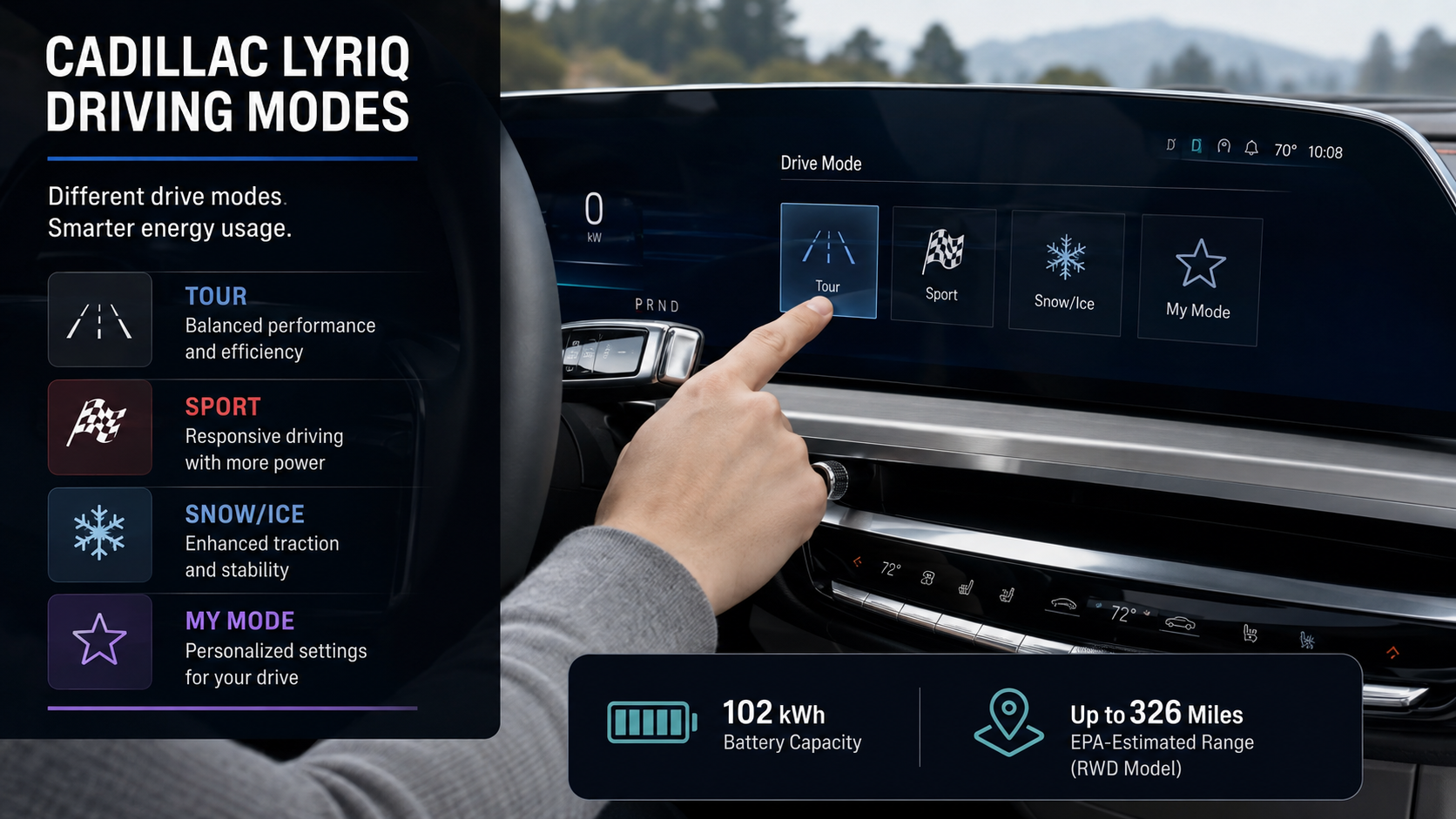
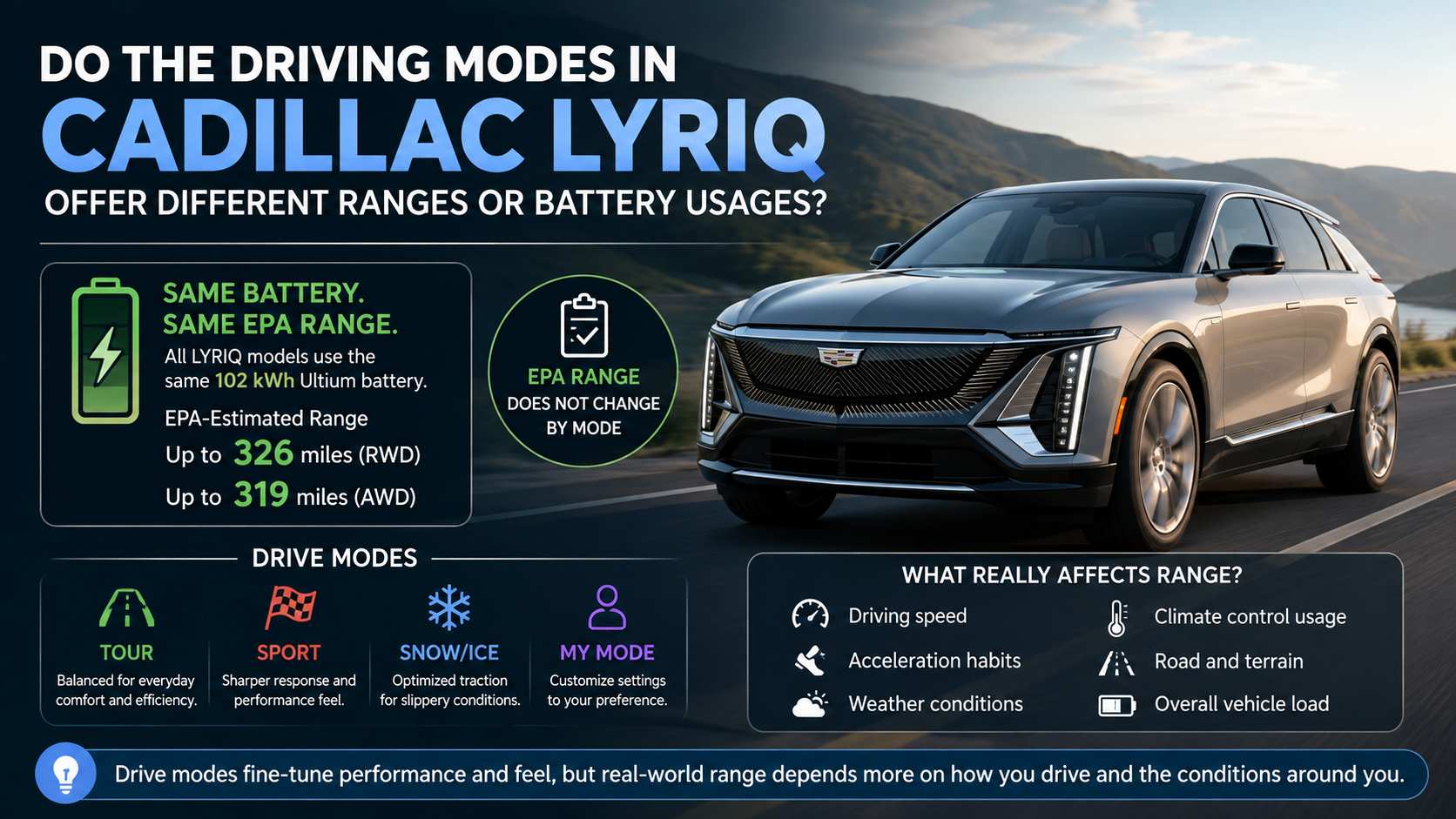
The Cadillac LYRIQ is a luxury electric SUV with several drive modes (Tour, Sport, Snow/Ice, and a customizable My Mode) designed to tailor the driving experience. Importantly, all LYRIQ models use the same 102 kWh Ultium battery pack, and their official EPA range ratings remain the same no matter which mode is selected. In other words, the battery capacity and EPA-estimated range (up to 326 miles for RWD, 319 mi for AWD) do not change with drive mode. However, the modes do adjust throttle mapping, steering feel, torque distribution and other settings, which can subtly influence how quickly that energy is consumed in real driving. In practice, Tour Mode (Cadillac’s default) typically delivers the most efficient usage, while Sport Mode and other performance-oriented modes can increase consumption if driven aggressively. Overall, factors like driving speed, acceleration habits, weather, and climate control usage usually have a far larger effect on range than the chosen drive mode.
Key Points:
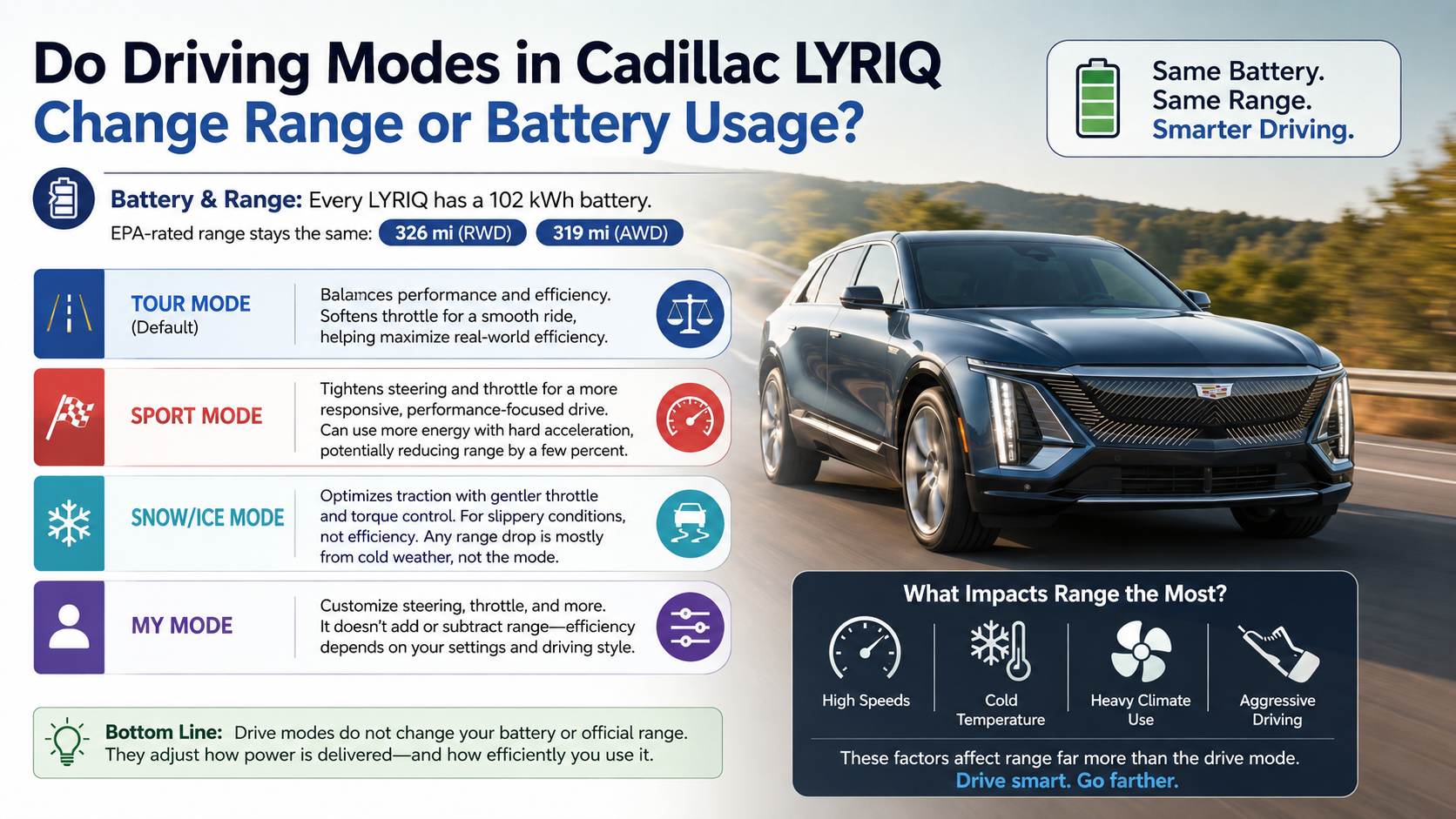
- Battery and Range: Every LYRIQ has a 102 kWh battery. The EPA-rated range (326 mi RWD, 319 mi AWD) stays the same regardless of drive mode. No mode can increase the battery’s energy capacity.
- Tour Mode (Default): This balances performance and efficiency. It softens throttle response and provides a smooth ride, helping to maximize real-world efficiency for everyday driving.
- Sport Mode: Tightens steering and throttle for a more responsive, performance-focused drive. It can use more energy if you accelerate hard, potentially shaving a few percent off range compared to Tour Mode. The impact is gradual – with gentle use, the difference is small.
- Snow/Ice Mode: Optimizes traction with gentler throttle and torque control. It’s for slippery conditions, not efficiency. Any range drop is mostly due to the cold weather itself and traction control, not the mode setting.
- My Mode: Lets you customize steering, throttle, etc. It neither adds nor subtracts range on its own – efficiency depends entirely on your chosen settings and driving style. For example, a soft throttle setting in My Mode can be as efficient as Tour, while an aggressive setup can mimic Sport.
- Major Range Factors: Real-world range is driven far more by speed, temperature, and driving style than by mode. For example, AAA found that cold weather alone can cut EV range by ~39%, dwarfing any effect from drive mode. High speeds, heavy climate use, or hard acceleration will reduce range much more than simply switching from Tour to Sport.
Tour Mode: Maximizing Everyday Efficiency
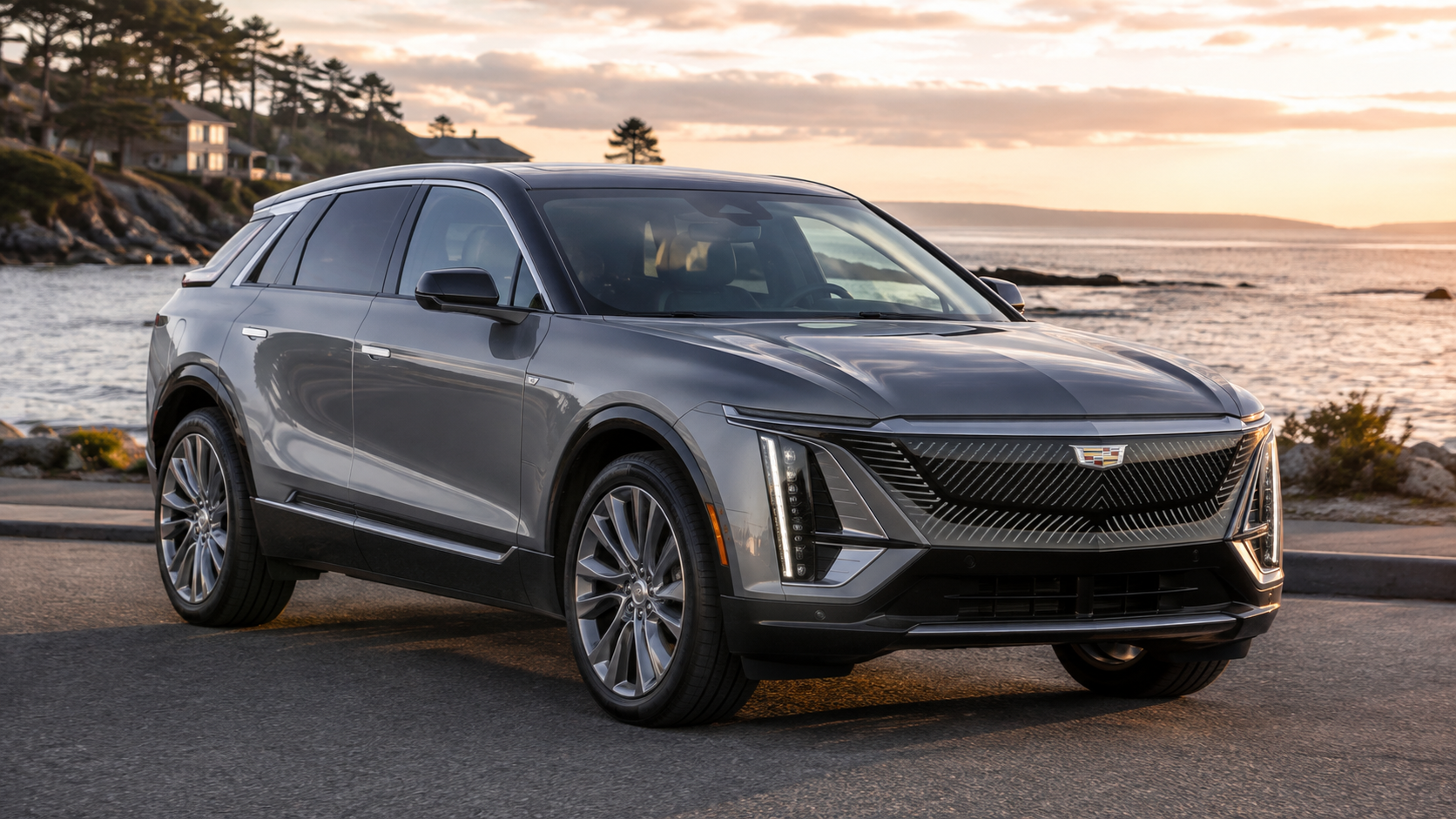
Tour Mode (sometimes called “Normal”) is the LYRIQ’s default driving mode and is engineered for smooth, economical operation. Cadillac’s documentation notes that Tour/Normal mode “optimizes fuel economy and drive quality” in daily driving. In Tour Mode, the LYRIQ uses a gentle throttle map and relaxed steering, which reduces sudden power surges. As one analysis puts it, Tour Mode’s accelerator mapping is “responsive but not overly aggressive,” reducing unnecessary energy draw during typical stop-and-go or highway cruising. Most drivers will find that Tour Mode delivers the highest real-world efficiency: if your goal is to stretch every mile on a charge, Tour Mode is generally best. In practice, drivers often achieve roughly 3.0–3.3 miles per kWh in Tour Mode under normal conditions, aligning closely with EPA test patterns (which use a similar conservative driving style).
In summary, Tour Mode’s key effects are:
- Throttle Response: Smooth and moderate. The car accelerates gradually, which avoids spikes in power draw.
- Steering and Suspension: Steering feels light and comfortable. Any adaptive dampers stay in their most relaxed setting for ride comfort.
- Regeneration: Tour Mode allows the standard level of regenerative braking (the same as other modes), so energy recapture on deceleration is unchanged.
Because Tour Mode effectively encourages “eco-friendly” driving inputs, it typically yields the longest range in day-to-day use. It is also the mode most closely aligned with how the LYRIQ was driven during EPA range testing, meaning its drive feel is often used as the baseline for official range numbers.
Sport Mode: Enhanced Performance, Increased Energy Use
Sport Mode sharpens the LYRIQ’s throttle and steering for a more engaging drive. In Sport, throttle mapping is more aggressive: even a light press on the accelerator produces quicker acceleration than in Tour Mode. The steering becomes heavier and more responsive. In practical terms, this makes merging and passing easier, and the vehicle feels more eager to move.
However, this performance comes at an efficiency cost. As the manufacturer notes, Sport Mode “tightens steering response and sharpens throttle mapping”, which means the battery supplies power more aggressively when you accelerate. Multiple analyses confirm that driving in Sport Mode will generally use more battery energy than Tour Mode if driven the same way. For example, one review suggests Sport Mode can incur roughly a few percent higher consumption, translating to perhaps tens of miles less range on a full charge if driven spiritedly. In other words, if you keep your foot light and maintain steady speeds, the difference between Tour and Sport can be small; but if you frequently accelerate hard, Sport Mode will cause the LYRIQ to burn through its 102 kWh faster.
Key points about Sport Mode:
- Throttle: Much more responsive. Light pedal input yields quick power.
- Energy Use: Increases when driven aggressively. You may see a 5–15% higher power draw during rapid acceleration versus Tour Mode. Over many miles, that can reduce range by a similar percentage if the driving style stays aggressive.
- Range Effect: Cadillac explains that Sport doesn’t change the battery itself, but encouraging you to accelerate faster means more energy use. Sport Mode itself won’t instantly drain the battery – it’s only through harder driving that range drops faster.
In summary, use Sport Mode when you want performance and responsiveness (e.g. merging, passing, spirited drives). If your aim is maximum range, switch back to Tour Mode.
Snow/Ice Mode: Prioritizing Traction in Winter
Snow/Ice Mode is designed for slippery conditions. It softens throttle response and alters torque distribution to prevent wheelspin on snow, ice, or rain. In practical terms, when Snow/Ice Mode is engaged:
- The accelerator pedal feels more gradual (it takes a firmer press to get the same response).
- Stability and traction control intervenes more aggressively to avoid slip. On AWD models, the torque split may favor more front/rear balance as needed.
- Steering response is slightly eased for stability.
All of this helps keep the SUV planted in low-traction situations. However, Snow/Ice Mode is not intended to improve efficiency. In fact, it can slightly increase energy usage in those conditions. Why? Because managing traction (e.g. spinning wheels a little to gain grip) can waste energy compared to smooth rolling. More importantly, Snow/Ice Mode is usually activated in winter, so the car is also fighting cold temperatures. Cold weather reduces battery efficiency and forces use of cabin heating – both of which dramatically cut range, often 20–40% compared to summer.
Cadillac and analysts emphasize that the bulk of any range loss during winter driving comes from the cold itself, not the mode setting. As one source notes, “limited range in winter is typically due to cold weather, winter tires, road conditions and increased climate use, not the drive mode”. In short, Snow/Ice Mode trades a bit of efficiency for safety and control. Use it when needed for traction, but be aware that any range drop you see is largely the result of the environment and driving conditions, rather than Snow/Ice Mode magically using up battery life.
My Mode (Custom): Flexible Preferences with No Fixed Impact
My Mode lets the driver customize steering feel, throttle sensitivity, and even vehicle sound in a personalized profile. Depending on the model year and trim, you can create a “favorite” driving setup. The key thing is that My Mode itself doesn’t inherently add power or efficiency; it simply applies your chosen settings as if you created a custom mode.
This means energy usage in My Mode is highly variable. For example:
- If you configure My Mode with softer throttle response, firm regenerative braking, and relaxed steering, you can effectively mimic Tour Mode’s efficiency. This setup will help conserve energy similar to the default economy settings.
- If you choose snappier throttle and tighter steering, My Mode can feel like Sport Mode, and you’ll use more energy when accelerating.
Industry write-ups point out that “My Mode does not provide any extra battery power and doesn’t boost the official driving range… the amount of energy that will be used is almost entirely determined by how you have set the parameters and how you drive.” In other words, My Mode offers consistent control – it keeps the car driving the way you like – but the efficiency outcome depends on whether you’ve dialed in “eco” or “sport” settings. The best way to use My Mode for efficiency is to set it gently (like Tour Mode). If used to create a sporty profile, expect similar consumption to Sport Mode.
Performance Variant (LYRIQ-V) Modes
For completeness: Cadillac’s high-performance LYRIQ-V model has additional modes (such as V-Mode, Competitive Mode, Velocity Max) geared toward track-style driving. These modes unlock the SUV’s full 615 hp and 650 lb-ft in short bursts. However, the LYRIQ-V’s EPA range is already lower (about 285 miles for the dual-motor AWD setup). Regular use of performance modes will dramatically increase energy draw, pushing real-world range well below even that 285-mile rating. For example, driving in Velocity Max can rapidly deplete the battery. These modes are intended for occasional sporty driving, not commuting. Most LYRIQ owners will never need these modes for daily use, and they exemplify that increased performance always comes at the cost of range.
Battery Capacity and EPA Range
It’s important to stress that none of the drive modes changes the LYRIQ’s battery capacity or official range. All 2023–2027 LYRIQ models use a 102 kWh lithium-ion battery pack. This fixed capacity provides the energy for the EPA range. Cadillac’s official numbers are up to 326 miles (single-motor RWD) and 319 miles (dual-motor AWD with standard charger). The more-powerful LYRIQ-V is EPA-rated around 285 miles. These figures are determined under standardized test cycles, which always use a single mode and driving profile.
In fact, Cadillac’s EPA certification does not test each drive mode separately. As one analysis explains, the EPA’s dynamometer tests run a fixed driving schedule (city and highway cycles) with one drive mode – typically the default Tour/Normal calibration. The resulting range number is printed on the window sticker. Cadillac does not and cannot publish different EPA ranges for Sport or Snow modes because the testing procedures don’t include those settings.
In practical terms, when you look at the LYRIQ’s estimated range display, it will not change simply because you switched modes. The estimated miles-to-empty are based on current battery state, recent driving efficiency, and other factors, but not on a fixed “mode” multiplier. If you drive the same route twice – once in Tour and once in Sport – your actual battery usage might differ slightly, but the LYRIQ will track that in its real-time estimate (which can fluctuate) rather than showing a mode-specific range label.
Finally, it’s worth noting that GM has improved the LYRIQ’s efficiency over time. Early 2023/2024 RWD models were rated around 314 miles, but later updates (2025+) raised RWD to 326 and AWD to 319/303 as shown above. These changes come from software/hardware tweaks, not drive mode changes.
Real-World Efficiency: More Than Just Mode
When it comes to real-world range, drive mode is usually one of the least significant variables. Numerous tests and owner reports show that factors such as speed, acceleration habits, temperature, and accessories have a far larger impact. For example:
- Driving speed: Range falls sharply at highway speeds due to aerodynamic drag. One analysis tool shows LYRIQ range dropping from about 326 miles at moderate speeds to well under 270 miles at 75–80 mph. (The drag force grows roughly with the cube of speed.) No amount of mode tuning can overcome physics.
- Driving style: Frequent hard accelerations and high-speed launches (often done in Sport Mode) consume disproportionate energy. A gentle, steady drive extends range.
- Temperature: Cold or hot weather can reduce range dramatically. AAA found that at 20°F, EV range typically drops ~39% on average, far more than any mode swap. The LYRIQ itself is heat-pump equipped, but heat for cabin and cold battery losses still cut range.
- Climate control: Running the heater or AC on high draws kilowatts of power. In winter, keeping the cabin warm is one of the biggest drains, even if you’re in Tour Mode.
- Tire size and drivetrain: Larger wheels and AWD models incur more rolling resistance and drag. For instance, an AWD LYRIQ (326 mi RWD vs 319 mi AWD official) starts with slightly lower efficiency due to the extra motor and drivetrain mass.
- Regenerative braking: Fortunately, the LYRIQ’s regen braking strength is the same in all modes. Cadillac owners have noted that choosing Sport vs Tour does not reduce regen – the motor will recapture energy the same way when you lift off the pedal. So Sport Mode only “wastes” range when it encourages you to press the throttle harder, not because it disables energy recovery.
As a result of these factors, the range difference between modes in normal conditions is relatively small. In Tour Mode, you’re simply using the same energy more conservatively, so the LYRIQ may show a slightly higher miles-per-kWh figure. In Sport Mode, expect a small drop in efficiency if you use the extra throttle. Snow/Ice Mode’s effect is mostly indirect (through weather and traction control). Many LYRIQ owners report that switching between Tour and Sport on a given drive only changes their range by a few percent at most, provided their driving stays similar.
Below is a simplified comparison of the LYRIQ’s main drive modes:
| Drive Mode | Throttle Response | Steering Feel | Best For | Impact on Range/Efficiency |
|---|---|---|---|---|
| Tour (Normal) | Smooth and gradual | Light & comfortable | Daily commuting and cruising | Baseline efficiency. Typically yields the highest real-world range because acceleration is gentle. |
| Sport | Very responsive | Firmer, heavier | Merging, passing, spirited driving | Higher power use. Encourages quicker acceleration, which can reduce range by several percent over long runs if driven aggressively. |
| Snow/Ice | Gentler, slow to react | More stable control | Snow, ice, rain (slippery roads) | Minimal direct effect. Softens throttle and adds traction control for safety. Range loss is mostly due to cold weather and traction control, not the mode itself. |
| My Mode (Custom) | Adjustable by driver | Adjustable by driver | Personalized driving feel | Varies. Energy use depends on your settings. A “soft” setup mimics Tour Mode (efficient), a “sharp” setup mimics Sport (uses more power). |
Selecting the Right Mode
In practice, most daily driving is best done in Tour Mode to maximize efficiency. It provides smooth acceleration and conserves energy without sacrificing normal performance. Switch to Sport Mode when you want a sportier feel—e.g. merging onto the highway or when you want quicker throttle response. Snow/Ice Mode should be used when roads are slick; don’t rely on it to extend range, but trust it to keep the car stable. Use My Mode if you have specific preferences (for example, you might save one My Mode profile for city driving and another for highway driving).
Above all, remember that drive mode is a tool, not a magic range extender. The LYRIQ’s efficiency is shaped more by how and where you drive than by what mode it’s in. To get the most out of a charge: keep speeds moderate, accelerate smoothly, use regenerative braking, and minimize extra loads (heavy climate use, roof racks, etc.).
Also Read: Connections Hint Today Mashable | Clues and Answers for August 21, 2026
Frequently Asked Questions
Does changing drive modes alter the LYRIQ’s EPA range?
No. Cadillac’s official range ratings do not change with drive mode. All LYRIQs use the same 102 kWh battery, so the EPA range figures (e.g. 326 mi RWD) are fixed. Drive modes only change how that energy is used. In other words, your window-sticker range stays the same, though your actual mileage per charge in use may vary slightly by mode.
Will Sport Mode reduce my LYRIQ’s range?
Sport Mode can reduce efficiency if you use the faster throttle response. Cadillac notes that Sport “asks the battery for power more aggressively”. In practice, if you frequently accelerate hard, expect to see your mileage drop a few percent compared to driving in Tour Mode. However, if you drive gently in Sport Mode, the efficiency difference is minor. Sport Mode itself does not secretly drain the battery – it’s the way it invites harder driving that costs range.
What about Snow/Ice Mode – does that use more battery?
Snow/Ice Mode is designed for safety on slippery roads, not for saving power. It softens the throttle and adds traction control. Using Snow/Ice Mode will not give you any extra range; in fact, it might use slightly more energy because it’s fighting for grip. In real winter conditions, you’ll notice reduced range, but that’s almost entirely due to the cold weather (and heating the cabin), not the drive mode itself.
Can My Mode be set to improve efficiency?
Yes. My Mode itself just applies your settings. If you configure My Mode with a relaxed (soft) throttle response, strong regen, and normal steering, you can essentially match the efficiency of Tour Mode. Conversely, an aggressive My Mode setup will mimic Sport. The real determinant is how smoothly and gently you drive.
Which factors affect LYRIQ’s range more than driving mode?
By far, temperature, speed, and driving habits have the greatest impact. Cold weather (below ~50°F) can slash range by 20–40%. Driving 80 mph instead of 65 mph can cut range significantly. Using heating or air conditioning, climbing hills, or carrying heavy loads (cargo, towing) all matter far more than the choice between Tour or Sport. In head-to-head comparisons, swapping modes might only shift efficiency by a few percent, whereas these other factors can change range by tens of percent.
Summary
Cadillac’s various drive modes let you tune the LYRIQ for comfort, performance, or conditions, but they do not change the battery size or the officially rated range. Tour Mode is generally best for getting the most miles per charge, Sport Mode offers sharper performance at a slight efficiency cost, and Snow/Ice Mode enhances traction on slippery roads (with its own minor energy trade-off mostly due to weather). My Mode allows customization that can mimic either Eco or Sport behavior. Ultimately, to maximize range in a LYRIQ, focus on steady, moderate driving and temperature management; the drive mode is a secondary factor. All of these points are confirmed by Cadillac’s specifications and expert reviewers, providing a clear picture of how the modes affect real-world battery usage in the LYRIQ.
Sources: Cadillac LYRIQ official specs and owner information; technical analyses and Cadillac dealer publications; industry studies on EV efficiency. These sources confirm that LYRIQ drive modes adjust performance settings, not battery capacity, and that range differences are driven mostly by driving conditions and style.

12 Comments
Pingback: When Was the Game Innerlifthunt Released?
Pingback: Do the Driving Modes in Cadillac Lyriq Offer Different Ranges or Battery Usages?
Pingback: Do the Driving Modes in Cadillac LYRIQ Offer Different Ranges or Battery Usages? - News District
Pingback: The Growing Role of Digital Innovation in Patient Care - coremagazine.co.uk
Pingback: Do the Driving Modes in Cadillac LYRIQ Offer Different Ranges or Battery Usages?
Pingback: Do the Driving Modes in Cadillac LYRIQ Offer Different Ranges or Battery Usages? -
Pingback: Do the Driving Modes in Cadillac LYRIQ Offer Different Ranges or Battery Usages? - vistaromagazine.co.uk
Pingback: Do the Driving Modes in Cadillac LYRIQ Offer Different Ranges or Battery Usages?
Pingback: Mreco.Airtel.com | What the Airtel Portal Really Is in 2026
Pingback: MKVCinemas Kim Review | Current Status, Shutdown, and What to Know
Pingback: MicroDisha Login | What It Is and How Access Works
Pingback: severna dakota: North Dakota’s Meaning, Cities and Key Facts