

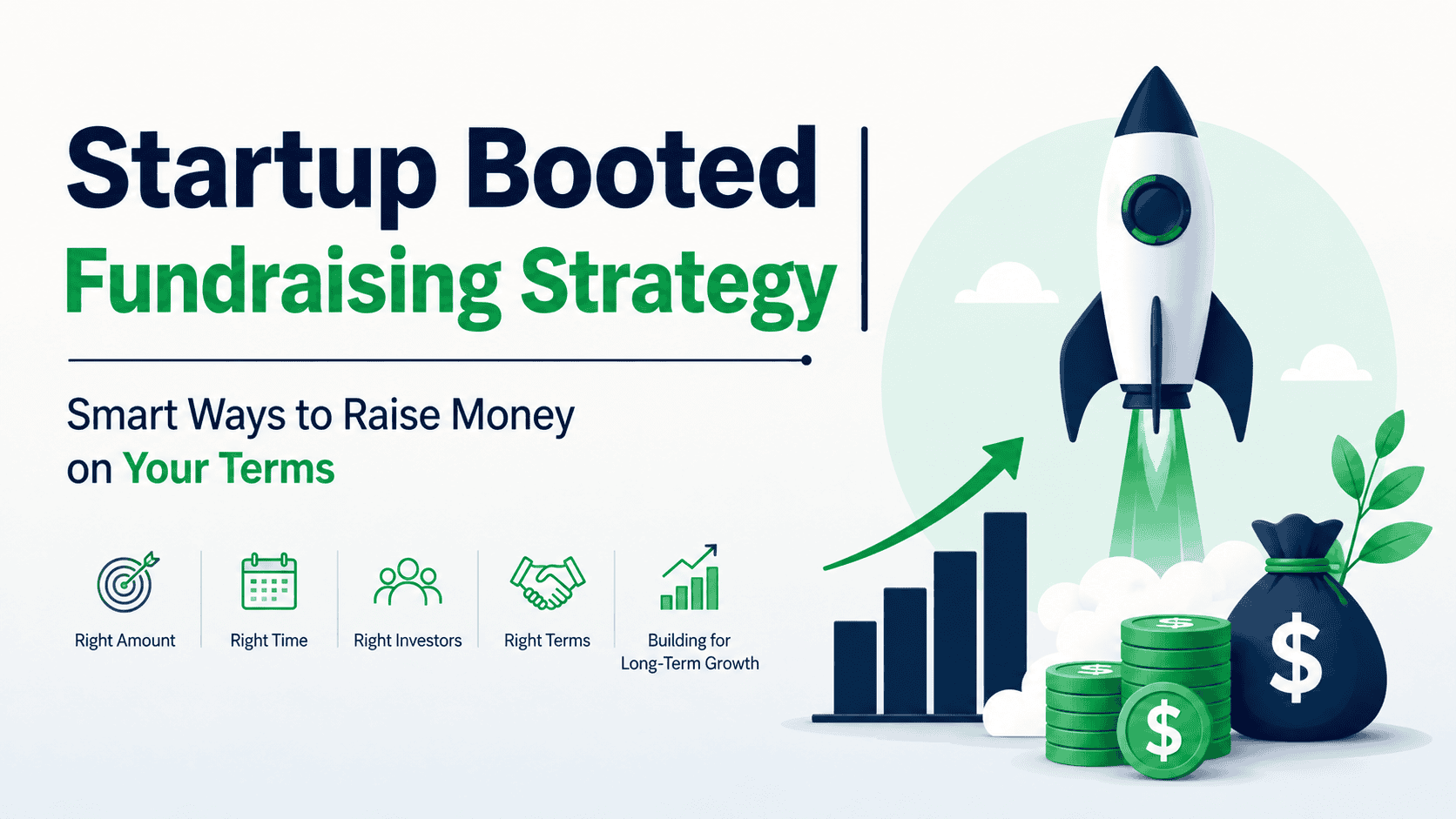
A strong startup fundraising strategy helps founders raise enough capital to reach important business goals without giving away more ownership, control, or flexibility than necessary.
The smartest approach is to match the funding source, timing, amount, and deal terms with the actual needs of the business.
What Is a Startup Fundraising Strategy?
A startup fundraising strategy is a structured plan for deciding how much money to raise, when to raise it, where to find investors or financing, and what terms to accept.
Fundraising is not simply about getting the largest possible investment. The right strategy considers the company’s cash needs, growth stage, ownership structure, revenue, risk, and future financing plans.
Common startup funding options include:
- Bootstrapping
- Friends and family funding
- Angel investment
- Venture capital
- Bank or business loans
- Revenue-based financing
- Crowdfunding
- Strategic investors
- SAFE agreements
- Convertible notes
- Startup grants
The best option depends on the company’s financial position and business model. The U.S. Small Business Administration notes that funding choices can affect how a business is structured and operated.
Start With a Clear Funding Requirement
Before contacting investors, determine exactly how much capital the startup needs.
A vague target such as “$1 million for growth” is difficult to evaluate. A stronger funding target connects the money to specific business activities.
For example, a startup might need funding for:
- Product development
- Hiring
- Marketing
- Technology infrastructure
- Inventory
- Sales expansion
- Regulatory requirements
- Working capital
Create a basic 12 to 18 month cash-flow forecast that shows expected income, expenses, hiring costs, and cash reserves.
A useful funding calculation is:
Required Funding = Planned Cash Expenses + Working Capital Reserve – Available Cash – Expected Operating Revenue
The number should include a reasonable reserve for unexpected costs without creating an unnecessarily large raise.
The SBA recommends forecasting sales, spending, and cash flow and using milestones and measurable assumptions when developing a lean business plan.
Choose the Right Fundraising Stage
A startup does not need the same type of capital at every stage.
| Startup Stage | Typical Funding Focus | Potential Funding Sources |
|---|---|---|
| Idea stage | Research and prototype | Founder funds, grants, friends and family |
| Prototype stage | Product development and testing | Angels, accelerators, grants |
| Early traction | Customers and market validation | Angels, seed investors, SAFE |
| Growth stage | Hiring and expansion | Venture capital, strategic investors |
| Scale stage | Large market expansion | Venture capital, growth financing, debt |
The goal is to raise enough money to reach the next meaningful milestone.
That milestone could be launching a product, reaching a revenue target, acquiring a specific number of customers, improving margins, or entering a new market.
Bootstrap Before You Raise Outside Capital
Bootstrapping means using the founder’s available resources or business revenue to finance operations.
This approach can reduce early dilution and give founders more control over strategic decisions. The SBA describes self-funding as a way to maintain control while also placing the financial risk on the founder.
Bootstrapping can include:
- Personal savings
- Early customer revenue
- Preorders
- Service revenue
- Founder contributions
- Reinvested profits
For businesses that can reach customers without major upfront investment, generating revenue before raising outside capital can strengthen the company’s negotiating position.
However, founders should avoid putting personal finances at unreasonable risk. Funding a startup entirely from personal resources may create financial pressure that limits the company’s ability to operate.
Use Customer Revenue as a Funding Source
Customer revenue can be one of the most valuable forms of startup financing because it does not normally require giving investors an ownership stake.
Revenue can come from:
- Preorders
- Subscriptions
- Annual contracts
- Deposits
- Pilot programs
- Paid beta programs
- Enterprise contracts
A startup with paying customers can often demonstrate market demand more effectively than one with only projections.
Early revenue also helps founders understand customer acquisition costs, pricing, retention, gross margins, and recurring revenue.
These metrics become important when speaking with investors.
Raise From Angel Investors
Angel investors are individuals who invest their own money in early-stage companies.
Angels can provide more than capital. Depending on the investor, they may offer industry knowledge, contacts, hiring support, customer introductions, and strategic guidance.
The right angel should fit the startup’s:
- Industry
- Business stage
- Funding requirement
- Geographic market
- Growth model
- Long-term objectives
Do not choose an investor based only on the size of the proposed check.
An investor who understands the business and can provide useful support may be more valuable than an investor offering slightly more money.
The SBA recommends researching potential investors and understanding their experience with startup companies before entering a funding relationship.
Consider Venture Capital Carefully
Venture capital is designed primarily for businesses with significant growth potential.
VC firms generally invest in exchange for equity, and the relationship can involve meaningful influence over company decisions. The SBA notes that venture capital generally focuses on high-growth companies and can involve giving up a portion of ownership and control.
Venture capital may make sense when a startup needs substantial capital to pursue a large market opportunity.
It may be less suitable for a profitable company that prefers steady growth, independence, or long-term founder control.
Before accepting VC funding, founders should understand:
- Equity dilution
- Board rights
- Investor voting rights
- Liquidation preferences
- Future fundraising expectations
- Founder vesting
- Protective provisions
- Exit expectations
The amount of money raised should match the company’s growth strategy, not simply the amount an investor is willing to provide.
Understand SAFE Agreements
A SAFE, or Simple Agreement for Future Equity, allows an investor to provide capital in exchange for a future ownership interest when specified triggering events occur.
The SEC explains that a SAFE generally does not give the investor an immediate ownership interest. Instead, the future ownership interest is created when the relevant triggering event occurs, such as a future equity financing or acquisition.
Common SAFE terms can include:
- Valuation cap
- Discount rate
- Conversion provisions
- Pro rata rights
- Liquidity event provisions
For founders, the important issue is not simply how much cash the SAFE provides. It is how the SAFE could affect future ownership and dilution.
Several SAFEs issued at different terms can also make the capitalization table harder to understand.
A founder should model the potential conversion before signing multiple agreements.
Know How Convertible Notes Work
A convertible note is a form of financing that begins as debt and may convert into equity under defined conditions.
The SEC explains that convertible notes are often used in seed-stage financing because early startups can be difficult to value. A note may convert into preferred stock when a future financing round or another agreed event occurs.
Key terms may include:
- Principal amount
- Interest rate
- Maturity date
- Discount rate
- Valuation cap
- Conversion event
Because a convertible note is debt, founders need to understand the repayment and maturity provisions as well as the possible future equity dilution.
Compare SAFE and Convertible Note Financing
| Feature | SAFE | Convertible Note |
|---|---|---|
| Basic structure | Future equity agreement | Debt that may convert to equity |
| Interest | Generally no interest | Usually carries interest |
| Maturity date | Generally none | Usually included |
| Equity conversion | Triggered by defined events | Triggered by defined events |
| Early valuation | Often deferred | Often deferred |
| Common use | Early-stage financing | Seed financing |
The specific terms can vary significantly between agreements. Founders should review the actual documents rather than assuming every SAFE or note has identical conditions.
Use Debt When Revenue Can Support Repayment
Business debt can preserve ownership because lenders generally receive repayment rather than an equity stake.
Possible sources include:
- Business loans
- Lines of credit
- Equipment financing
- Revenue-based financing
- Invoice financing
Debt can be useful for a startup with predictable revenue and a clear ability to service the obligation.
It may be risky for an early-stage company with uncertain cash flow.
A founder should compare the total repayment cost, interest rate, fees, collateral requirements, repayment schedule, and financial covenants before accepting debt.
Explore Grants and Non-Dilutive Funding
Non-dilutive funding does not normally require founders to give investors an ownership stake.
Potential sources include:
- Government grants
- Research grants
- University programs
- Industry competitions
- Accelerator awards
- Innovation programs
Eligibility rules vary widely.
Grants can be particularly useful for startups working in areas such as technology, scientific research, clean energy, healthcare, manufacturing, and other innovation-focused fields.
Because grants often have specific eligibility and reporting requirements, founders should verify the current rules directly with the relevant funding organization.
Consider Crowdfunding
Crowdfunding can help startups raise money from a broader group of supporters or investors.
There are several different models, including reward-based crowdfunding and investment crowdfunding.
With securities crowdfunding, legal requirements can apply to the offering, disclosures, intermediaries, investor limits, and reporting.
Founders should not treat crowdfunding as simply an online marketing campaign. It can create significant legal, financial, and administrative responsibilities.
The SEC provides specific information about startup securities and capital-raising structures, including equity and convertible instruments.
Also Read: Profitable Intraday Trading Advice 66unblockedgames.com | Tips for Smarter Trading
Build a Strong Investor Pitch
A fundraising pitch should explain the business clearly and quickly.
A strong pitch normally covers:
- Problem
- Solution
- Target market
- Business model
- Current traction
- Competitive position
- Team
- Financial performance
- Funding requirement
- Use of funds
Investors need enough information to understand why the business can grow and what the requested capital will accomplish.
Avoid unnecessary claims and unsupported market-size numbers.
Use measurable evidence whenever possible.
Examples include:
Monthly recurring revenue, customer retention, conversion rate, gross margin, customer acquisition cost, average revenue per customer, and growth rate.
Prepare for Investor Due Diligence
Fundraising can become difficult when important company information is incomplete.
Prepare a secure due diligence data room containing relevant documents.
| Category | Documents to Prepare |
|---|---|
| Corporate | Formation documents, ownership records, shareholder information |
| Financial | Income statements, balance sheets, cash-flow statements |
| Tax | Relevant tax filings and records |
| Legal | Material contracts, licenses, legal agreements |
| Intellectual property | Trademarks, patents, assignments, licenses |
| Employees | Employment agreements and equity arrangements |
| Customers | Major customer contracts and commercial agreements |
| Fundraising | Previous financing documents and capitalization table |
The SBA describes investor due diligence as a process that can involve reviewing management, products or services, corporate governance documents, and financial statements.
Keep the Capitalization Table Accurate
A capitalization table, commonly called a cap table, shows who owns the company and how ownership may change through financing.
It should account for:
- Founder shares
- Investor shares
- Employee options
- SAFEs
- Convertible notes
- Warrants
- Other equity rights
A founder should understand the potential ownership impact before accepting new capital.
For example, a funding offer can appear attractive because of its dollar value while creating substantial dilution through its valuation cap, discount, option pool requirements, or other terms.
Good cap table management is therefore an important part of maintaining control.
Negotiate More Than the Valuation
Startup fundraising terms involve more than the headline valuation.
Important terms can include:
- Valuation
- Investment amount
- Equity percentage
- Board representation
- Voting rights
- Liquidation preference
- Anti-dilution provisions
- Founder vesting
- Information rights
- Pro rata rights
- Protective provisions
A higher valuation is not always a better deal.
For example, an investment with a higher valuation but aggressive investor rights can create more restrictions than a lower valuation with balanced terms.
Founders should evaluate the complete financing package rather than focusing on one number.
Set a Fundraising Target Based on Milestones
A useful fundraising strategy connects capital to specific business milestones.
| Funding Goal | Example Milestone |
|---|---|
| Product funding | Launch a market-ready product |
| Sales funding | Build and test a sales process |
| Marketing funding | Reach a defined customer acquisition target |
| Hiring funding | Build a specific operating team |
| Expansion funding | Enter a new market |
| Growth funding | Reach a measurable revenue target |
The objective is to create enough runway to reach the next milestone and generate stronger evidence for the following financing decision.
Raise Money Before the Cash Becomes Urgent
Fundraising can become much harder when a startup has only a few weeks of cash remaining.
Founders should monitor monthly burn, available cash, expected revenue, and runway.
A simple runway calculation is:
Runway in Months = Cash Available ÷ Average Monthly Net Burn
For example, a company with $300,000 in available cash and an average monthly net burn of $30,000 has approximately 10 months of runway, before considering future changes in revenue or expenses.
Starting the fundraising process early gives founders more time to compare offers and negotiate terms.
Build Investor Relationships Before the Raise
Fundraising is often easier when investor relationships already exist.
Founders can develop relationships through:
- Industry events
- Startup accelerators
- Founder communities
- Professional introductions
- Customer networks
- Advisors
- Industry conferences
The purpose is not to ask every contact for money.
The goal is to build a network of people who understand the market and may become investors, advisors, customers, partners, or referral sources.
Use a Focused Investor List
Do not send the same pitch to every investor.
Build a targeted list based on:
Investment stage, industry, typical check size, geographic focus, portfolio companies, and business model.
An investor specializing in early-stage software may not be the right target for a capital-intensive manufacturing startup.
Investor research can also reveal potential conflicts with existing portfolio companies.
A focused list usually creates a more efficient fundraising process than sending large volumes of generic outreach.
Create a Simple Fundraising Process
A structured process helps founders maintain control.
A practical sequence is:
Define funding needs → Prepare financials → Build investor materials → Identify suitable investors → Start conversations → Conduct diligence → Compare terms → Negotiate → Complete legal documentation → Close funding
Keep a record of:
- Investor name
- Contact
- Investment focus
- Date contacted
- Current stage
- Questions raised
- Requested documents
- Next action
- Potential commitment
This prevents communication gaps and makes the fundraising pipeline easier to manage.
Avoid Raising More Than the Business Can Use Efficiently
A larger round is not automatically better.
Excess capital can increase:
Dilution, spending pressure, hiring commitments, and investor expectations.
The right amount is enough to achieve clearly defined milestones while maintaining a reasonable cash reserve.
The SBA emphasizes that there is no single funding solution for every business and that funding requirements should be based on the company’s specific circumstances.
Understand the Cost of Every Funding Source
Every funding method has a cost.
| Funding Method | Main Cost or Trade-Off |
|---|---|
| Bootstrapping | Founder carries financial risk |
| Friends and family | Financial and personal relationship risk |
| Angel investment | Ownership dilution |
| Venture capital | Dilution and possible loss of control |
| SAFE | Future equity dilution |
| Convertible note | Debt obligations plus potential dilution |
| Loan | Interest and repayment |
| Crowdfunding | Fees, legal requirements, and investor obligations |
| Grant | Eligibility and reporting requirements |
The best choice is the one that provides useful capital while keeping the company’s risk and long-term obligations manageable.
Protect Founder Control With Better Planning
Maintaining control starts before the investment agreement is signed.
Founders should understand:
Who controls the board, who has voting rights, how future financing affects ownership, and which decisions require investor approval.
Control can change even when founders continue to own a large percentage of shares.
Reviewing governance provisions alongside the financial terms helps founders understand the complete impact of a financing deal.
Keep Fundraising Documents Professional
Investors expect accurate and consistent information.
Make sure the following documents use matching numbers and assumptions:
- Pitch deck
- Financial model
- Cap table
- Business plan
- Investor update
- Term sheet
- Company accounts
Inconsistent revenue figures or ownership information can damage investor confidence.
Important legal and securities documents should also be reviewed by qualified legal and financial professionals.
Common Fundraising Mistakes to Avoid
Raising Without a Specific Purpose
A startup should know what the capital will achieve before asking investors for money.
Choosing Investors Only for Money
The wrong investor can create unnecessary conflicts around strategy, governance, hiring, or future financing.
Ignoring Dilution
Founders should model the effect of new equity, SAFEs, notes, and option pools before accepting capital.
Waiting Until Cash Is Almost Gone
A weak cash position reduces negotiating leverage and can force founders to accept less favorable terms.
Using Unclear Financial Projections
Financial forecasts should be based on identifiable assumptions and realistic business drivers.
Focusing Only on Valuation
The financing’s rights, restrictions, preferences, and future effects can matter as much as the valuation.
Skipping Professional Legal Review
Investment agreements can create long-term obligations. Qualified professionals should review documents before they are signed.
Also Read: Droven.io USA Tech Market Updates | AI, Cloud, Cybersecurity & More
How to Raise Money on Your Terms
A founder has greater negotiating power when the company can demonstrate traction, disciplined spending, clear financial records, and multiple potential funding options.
The core strategy is simple:
Raise the right amount, from the right source, at the right stage, for clearly defined milestones.
A startup that can generate revenue or operate efficiently before seeking external capital may have more flexibility than a company that must immediately depend on outside investors.
When external funding is necessary, founders should compare equity, debt, SAFE agreements, convertible notes, grants, crowdfunding, and strategic capital based on their actual costs and obligations.
The SEC recognizes stock, convertible instruments, SAFEs, and debt as common financing structures used by startups, with different ownership and financial implications.
Sources
U.S. Securities and Exchange Commission, Common Startup Securities
U.S. Securities and Exchange Commission, Small Business Glossary
U.S. Small Business Administration, Plan Your Business and Funding Guidance
U.S. Small Business Administration, Lean Business Planning Guidance

2 Comments
Pingback: Benighted Crossword Clue Answer | Solve the Puzzle Easily
Pingback: Thestripesblog Contact Fisher | How to Reach Frank Fisher in 2026